
Behavioral health practices rarely fail because clinicians stop caring. They fail at the seams: billing that does not match the clinical note, scheduling tools that treat ongoing therapy like a one-off dental visit, and documentation that pushes charting into the evening hours. Valant was built specifically to close those seams. Yet its public reputation splits sharply. Across major review platforms, a large sample of 338 reviews averages 4.2 out of 5, while a smaller sample of 15 reviews sits at 3.0 out of 5. That gap, more than any feature list, is what a practice actually needs to understand before signing.
This review treats that divergence as the central question: who gets the 4.2 experience, who gets the 3.0 experience, and what separates them.
Why Valant Built an EHR Only for Behavioral Health
Valant was founded in 2005 in Seattle by a practicing psychiatrist and his brother, a software developer. The platform grew out of frustration with electronic health record systems designed for primary care and general medicine, which mapped poorly onto behavioral health workflows.
The distinction matters. General medicine is largely episodic. Behavioral health is longitudinal: treatment runs across months or years, cases often involve co-occurring conditions, documentation follows formats such as SOAP and DAP notes, and reimbursement depends on specific behavioral health billing rules. Valant organizes everything around that reality, centering the platform on a single patient chart that surfaces treatment history, upcoming appointments, active medications, balances, and recent notes in one view.
The company has scaled on that focus. Valant reports serving more than 22,000 behavioral health professionals across all 50 states. After more than a decade of independent and venture backing, it received a growth investment from a private equity firm in December 2023. The platform is cloud based, ONC certified, and HIPAA compliant, with business associate agreements available.
How This Review Tested Valant
The Chart-to-Claim Method
Valant offers no free trial and no free plan, so a sandbox walkthrough is not possible for any independent reviewer. This assessment is therefore evidence based rather than hands-on: it synthesizes verified user reviews across major review platforms, product documentation, and independent industry coverage. Vendor-stated claims are labeled as such, and figures that could not be independently confirmed are identified as estimates.
The evaluation follows the actual lifecycle of a behavioral health encounter, from the first inquiry to a paid claim. The TechLinos editorial team calls this the Chart-to-Claim method, scoring six stages a behavioral health practice touches every working day.
| Evaluation stage | What it covers | Editorial score |
|---|---|---|
| Intake and scheduling | Prospective patient routing, self-scheduling, recurring and group appointments, reminders | 4.4 |
| Clinical documentation | Templates, carry-forward notes, treatment plans, AI Notes Assist | 4.3 |
| Prescribing and medication | E-prescribing, controlled substances, prescription monitoring, medication history | 4.5 |
| Billing and revenue cycle | Automated charges, claim checks, clearinghouse, eligibility, payment posting | 3.7 |
| Patient engagement | MYIO portal, telehealth, secure messaging, outcome-measure delivery | 3.8 |
| Reliability and support | Uptime, system stability, speed and quality of customer support | 3.0 |
| Composite editorial score | 3.9 | |
Inside Valant's Core Capabilities
Intake and scheduling
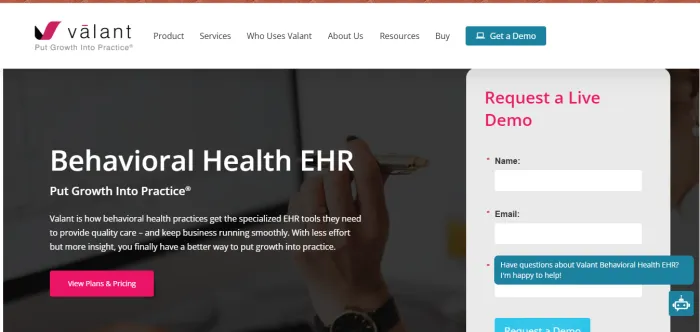
A prospective patient management tool lets practices receive structured service requests inside the EHR and match new inquiries to the right provider, reducing phone tag during intake. Scheduling supports individual, group, and recurring appointments, with separate calendar views per location or provider group. Patients can self-schedule through the MYIO portal, and automated reminders go out by text, email, or automated phone call. Valant recommends a cadence of three weeks, three days, and three hours before an appointment for certain patient groups. For structured programs, group therapy is handled with fixed memberships, attendance tracking, and waitlist management.
Clinical documentation
Documentation is the area users praise most consistently. The platform ships more than 100 configurable templates spanning psychiatric evaluations, SOAP, DAP, MFT, CBT, and DBT formats. Notes carry forward from prior sessions, automatically pulling diagnoses and medications so clinicians are not re-entering the same data weekly. Macros and content shortcuts speed common observations, and treatment plan goals are tracked inside the system with review reminders. The AI Notes Assist feature drafts structured clinical notes from session content, positioned as a way to cut documentation time. Reviewers repeatedly single out carry-forward notes and macros as the reason charting that once took hours now takes minutes.
Prescribing and medication management
This is where Valant separates itself from generalist behavioral health tools. E-prescribing covers controlled substances, integrates prescription monitoring, and tracks medication history, with prescription updates launching directly from the clinical note. For psychiatrists and psychiatric nurse practitioners, this depth is the main reason to consider the platform, and independent coverage describes it as one of the strongest options for prescribers who need medication management inside a workflow built for them.
Billing and revenue cycle
Billing is designed around behavioral health rules rather than retrofitted. Charges generate automatically when a service is scheduled. The Claim Assist feature checks charges against more than 100 behavioral health billing rules, correcting identifiable errors and flagging complex ones for review. Electronic claims route to payers through integrated clearinghouse partnerships, and electronic remittance advice supports automated payment posting. Insurance eligibility can be checked from the EHR, which the vendor reports at 94 percent accuracy, and a pending transactions queue acts as a pre-submission checkpoint. The design is sound, but billing is also where user complaints cluster.
Patient engagement and telehealth
The MYIO patient portal works on web and as a mobile app, with a magic-link login option that removes passwords. Patients complete intake and consent forms, sign documents, schedule, pay bills, and message providers securely. Telehealth is built in and HIPAA compliant, so patients join video sessions through the portal without separate software, and the system can prompt for payment before a session begins. Valant also schedules and auto-scores outcome measures, drawing on a library the vendor describes as more than 80 reportable measures, with results shown to clinicians and patients as visual progress graphs.
What the Ratings Reveal
The headline numbers tell two stories. The larger, more recent sample is broadly positive, while the smaller sample is mixed to negative. The honest reading is that experience depends heavily on practice size, billing complexity, and tolerance for a feature-dense system.
| Review sample | Average rating | Dominant signal |
|---|---|---|
| Larger sample (338 reviews) | 4.2 of 5 | Behavioral health fit and easy navigation praised; downtime and slow support criticized |
| Smaller sample (15 reviews) | 3.0 of 5 | Weighted toward setup difficulty, cost, and access issues |
In the larger sample, the most positive themes are concrete. Reviewers rate the behavioral health focus highly, describe navigation as intuitive once learned, and call onboarding and training resources supportive. The negative themes are equally concrete and recur often: frequent technical glitches and downtime, slow or inconsistent support responses, and challenging insurance claims management. One reviewer, a clinical psychologist, attributed roughly three months of denied claims to a problem at a clearinghouse interface. Another, a practice owner, reported the system going down every week or two. The vendor has publicly tied at least one late 2025 disruption to a broader cloud infrastructure outage rather than the platform itself.
The smaller sample skews harsher in part because so few reviews inform it. Its recurring dislikes are difficult setup, expense, calendar and access problems, and a sense of limited automation. One long-tenured reviewer described patient portal login trouble, video that worked only about two-thirds of the time, and incremental charges layered onto a long contract.
Strengths That Hold Up in Daily Use
Across both samples, a consistent set of strengths survives scrutiny rather than reading as marketing.
• Genuine behavioral health specialization. Templates, measures, treatment plans, and billing rules are built for mental health rather than adapted from general medicine, which reviewers repeatedly cite as the deciding factor.
• Prescriber depth. Controlled-substance e-prescribing, prescription monitoring, and medication history make it a strong fit for psychiatry and psychiatric nurse practitioners.
• Documentation efficiency. Carry-forward notes, macros, and AI Notes Assist measurably reduce charting time for clinicians who invest in learning the templates.
• Integrated revenue cycle. Automated charge creation, behavioral health claim checks, and clearinghouse routing consolidate billing that practices often run across separate tools.
• Measurement-based care built in. Auto-scored outcome measures with visual progress graphs support both clinical decisions and payer documentation.
Limitations Practices Report
The weaknesses are not subtle, and prospective buyers should weigh them directly.
Reliability is the single most common complaint. Across reviews, periodic downtime and system freezes are the dominant negative theme, and slow support responses are close behind.
• Stability and downtime. Recurring crashes and slow performance appear often enough in reviews to be treated as a real operational risk, not an outlier.
• Support responsiveness. Experiences range from excellent to frustrating, with multiple reviewers reporting unreturned voicemails and email-only replies that take days.
• Billing friction. Despite a strong design, claims integration issues and denials surface in a meaningful share of reviews, particularly around clearinghouse interfaces.
• Learning curve. The interface is feature dense and prioritizes function over polish, so onboarding takes real time, especially for larger practices.
• Mobile and add-on costs. The mobile experience for clinician documentation lags the web app, and reviewers note add-on charges for items such as extra reminders and additional electronic signatures, alongside annual contract commitments.
Pricing Without a Public Number
Valant does not publish pricing. It offers no free plan and no free trial, and costs are quoted per practice based on size and needs. That opacity is itself a planning constraint, since practices cannot benchmark or test before committing.
Independent estimates exist but are not vendor confirmed. Industry comparisons place typical per-provider monthly cost in the rough range of 200 to 400 dollars for small practices, 300 to 600 dollars for mid-sized practices, and custom pricing for larger organizations. These figures are estimates only and should be treated as directional, not quoted rates. Reviewers also flag that some features marketed as included, such as certain reminders, telehealth, or signatures beyond the first, can carry additional charges, so the quoted number and the all-in number may differ.
| Pricing factor | Detail |
|---|---|
| Public pricing | None. Custom quote per practice size and needs |
| Free trial or free plan | Not offered |
| Estimated range | Roughly 200 to 600 dollars per provider monthly, per independent industry estimates, not vendor confirmed |
| Contract | Annual commitments reported by reviewers, with possible add-on fees |
Which Practices Fit Valant
| Strong fit | Weaker fit |
|---|---|
| Psychiatry practices and prescribers needing controlled-substance e-prescribing | Solo practitioners with simple documentation and billing needs |
| Mid-sized to large group practices with dedicated administrative staff | Practices that require transparent pricing or a trial before commitment |
| Multi-location organizations and structured group therapy programs | Clinicians who rely heavily on mobile documentation |
| Practices committed to measurement-based care and outcome reporting | Teams with low tolerance for occasional downtime or slow support |
Verdict: A Specialist Tool With a Reliability Caveat
Valant earns its place as a purpose-built behavioral health EHR, and the depth shows most clearly for prescribers and growing group practices that have staff to manage a feature-dense system. Documentation efficiency, controlled-substance prescribing, integrated billing, and measurement-based care are real differentiators, not slogans, and they explain the solid 4.2 rating from a large sample.
The caveat is consistent enough to take seriously. Periodic downtime, uneven support, and billing friction are the recurring complaints, and the absence of public pricing or a trial means practices commit partly on faith. The right buyer is a behavioral health organization that values clinical and billing depth enough to absorb a learning curve and occasional instability. A solo clinician or a small practice with straightforward needs, by contrast, will likely find the platform heavier and costlier than the work requires. The 4.2 and the 3.0 are both true; which one a practice lives with depends largely on its size, its billing complexity, and how much it leans on the prescriber tools that justify the system in the first place.