The 30-Second Answer
Traditional search engines like Google retrieve a ranked list of web pages that match your keywords. AI search tools like RedeepSeek read your full question, retrieve relevant sources, and generate a single direct answer with citations. In 2026, 37% of consumers begin their searches with AI tools instead of Google, and 93% of queries inside Google’s own AI Mode end without a single click to a website. AI search wins for research, writing, coding, and document analysis. Traditional search still wins for transactional, navigational, and local queries. The smartest workflow uses both.
Key statistics at a glance
37% of consumers now start their search with an AI tool instead of Google | 2 B queries per day handled by ChatGPT alone in 2026 | 93% of searches in Google’s AI Mode end without a single click |
Why This Comparison Matters in 2026
For two decades, "search the web" meant one thing: open Google and scan ten blue links. That assumption is now breaking. Generative AI assistants - ChatGPT, Perplexity, Google’s own AI Mode, Microsoft Copilot, and newer entrants like RedeepSeek - are changing not only how people find information, but how they expect to receive it.
The behavioural shift is large enough to be measured. Position-1 organic clicks on Google have dropped roughly 58% over the last two years, even though Google still receives the majority of search query volume. Users haven’t stopped searching. They’ve stopped clicking, because the answer they wanted now appears directly inside an AI summary or a chat response.
This guide explains the technical and practical differences between the two paradigms, where a tool like RedeepSeek fits in, what the latest 2026 data shows, and how to choose the right tool for any given task.
What Is a Traditional Search Engine?
A traditional search engine is software that crawls the public web, builds a searchable index of the pages it finds, and returns a ranked list of those pages in response to a keyword query. Google, Bing, DuckDuckGo, and Yandex are all traditional search engines.
How traditional search works (3 steps)
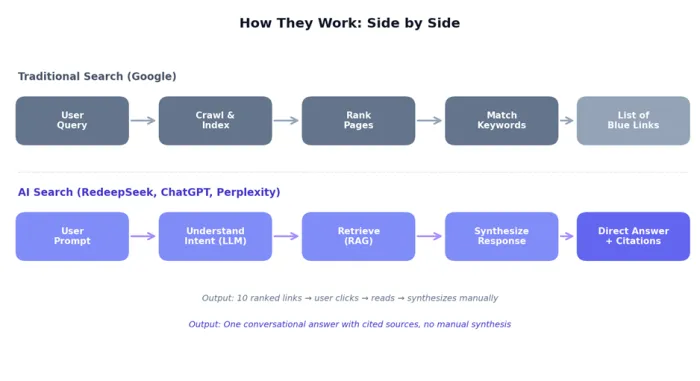
1. Crawling - automated bots like Googlebot follow links across the web to discover and revisit pages.
2. Indexing - each page is parsed and stored in a giant inverted index that maps keywords to documents.
3. Ranking - when you submit a query, the engine scores indexed pages on hundreds of signals (relevance, authority, freshness, links, user engagement) and returns the top results.
The output is always a list of links pointing back to real web pages. The user does the synthesis: open the tabs, read, compare, summarise.
What Is an AI Search Engine?
An AI search engine is a system built on top of a large language model (LLM) that interprets natural-language prompts, retrieves relevant information from the web or a private knowledge base, and generates a synthesized answer. RedeepSeek, ChatGPT with web search, Perplexity, Claude, and Google’s AI Mode are all AI search engines.
How AI search works (4 steps)
4. Intent understanding - the LLM reads the full prompt, including context from earlier turns in the conversation.
5. Query fan-out - the system breaks complex questions into smaller sub-queries and runs them in parallel.
6. Retrieval (RAG) - Retrieval-Augmented Generation pulls relevant passages from web sources and feeds them to the model as live context.
7. Synthesis - the model writes a single coherent answer in the user’s language, usually with inline citations to the sources used.
The output is one ready-to-use response, not a list of options to evaluate. That single design decision - generate, don’t list - is the root of every other difference between AI search and Google.
How They Work - Visual Comparison
Where RedeepSeek Fits Into the AI Search Landscape
RedeepSeek is a next-generation AI assistant that combines conversational chat, content generation, code help, document and image analysis, and real-time web search inside one interface. It supports more than 50 languages and is positioned as a daily productivity companion for professionals and teams - the same use cases where AI search has the strongest advantage over Google.
What RedeepSeek does that traditional search can’t
• Generates content directly - blog posts, emails, ad copy, product descriptions - tailored to your tone and audience.
• Answers questions about uploaded documents and images, including charts, screenshots, and PDFs.
• Writes, debugs, and explains code in 30+ programming languages, with awareness of the wider project context.
• Holds multi-turn conversations: you can ask a follow-up like "now translate that to French" without restating the question.
• Integrates web search with citations, so factual claims can be traced back to source URLs.
What RedeepSeek does NOT replace
• Buying a specific product on Amazon or booking a flight - those are transactional and still belong on the destination site.
• Finding the nearest hospital or coffee shop - local intent is still served best by Google Maps and the local pack.
• Live data like sports scores, breaking news headlines, and second-by-second stock quotes - traditional search updates faster.
Head-to-Head: RedeepSeek vs Google
The table below summarises the most important differences in one place.
| Feature | Traditional Search (Google) | AI Search (RedeepSeek) |
|---|---|---|
| Output format | Ranked list of 10 blue links | One direct, conversational answer |
| Core technology | Crawl, index, rank (keyword matching) | LLM + Retrieval-Augmented Generation (RAG) |
| Query style | Short keywords ("best CRM small business") | Full natural-language questions, follow-ups |
| Context handling | Each query is independent | Multi-turn memory across the conversation |
| Time to answer | User reads & synthesizes from many tabs | Synthesis is done; answer arrives ready to use |
| Source visibility | Every result is a citable URL | Cites a smaller curated set of sources |
| Best for | Transactional, navigational, local intent | Research, drafting, coding, document analysis |
| Risk | Information overload, ad clutter | Hallucinations if sources are weak; verify critical facts |
Table 1. Feature-by-feature comparison of traditional search and AI search assistants.
What the 2026 Data Says
Behaviour change is now visible in published research and platform-disclosed metrics. Three numbers tell most of the story:
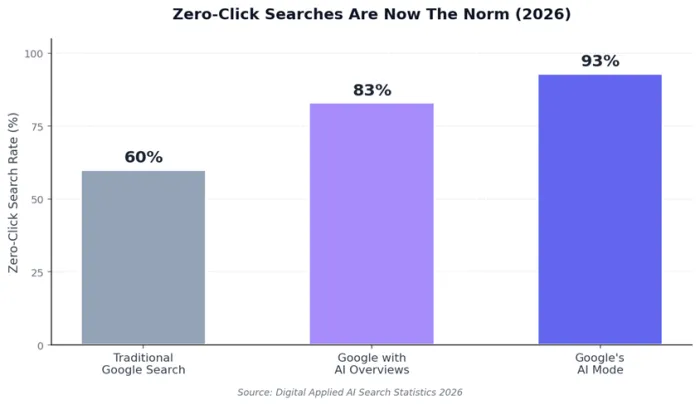
Zero-click search - searches that end without a click to any external website - has become the dominant behaviour. About 60% of regular Google searches now end without a click, rising to 83% when an AI Overview is shown and 93% inside Google’s AI Mode. The user got their answer on the results page.
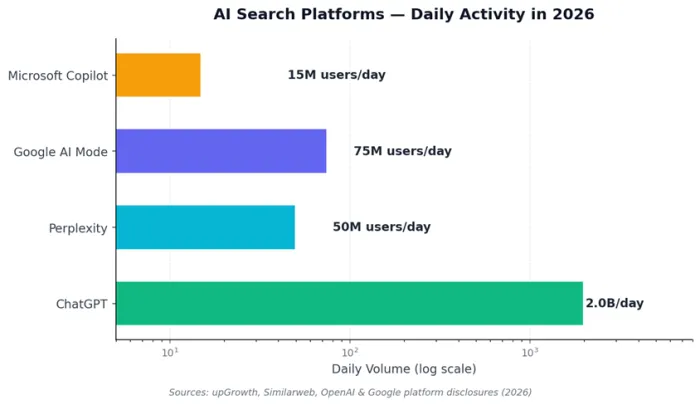
On the platform side, scale is no longer the question. ChatGPT processes roughly 2 billion queries every day. Google’s AI Mode has surpassed 75 million daily active users across more than 40 markets. Perplexity, the smallest of the major AI search engines, still handles over a billion queries per month. AI search is no longer an early-adopter category; it is mainstream.
And consumer preference is shifting at the source. A January 2026 Search Engine Land study found that 37% of consumers now start their searches with an AI tool rather than a traditional engine. Sixty percent of those respondents said AI gives "better, clearer answers" than traditional search; only 6% said it gave worse ones.
When to Use AI Search vs Google
The honest answer is "both, depending on the task." Treat them as complements, not substitutes. The table below maps common tasks to the better tool.
| Your task | Better tool |
|---|---|
| Buying a specific product or visiting a known site | Google (transactional/navigational) |
| Finding a local restaurant, doctor, or shop | Google (Maps + local pack) |
| Real-time stock prices, weather, sports scores | |
| Drafting an email, blog post, or product description | RedeepSeek |
| Summarizing a 40-page PDF or research paper | RedeepSeek |
| Debugging or explaining a block of code | RedeepSeek |
| Comparing 3 SaaS tools on features and pricing | RedeepSeek (then verify with Google) |
| Translating content into Spanish, French, Hindi, etc. | RedeepSeek |
| Citing a primary source for academic work | Google + library databases |
Table 2. Quick decision guide for picking the right search tool for the task.
Limitations You Should Know About
Limitations of AI search
• Hallucinations - LLMs can produce confident but factually wrong statements when sources are weak or absent. Always verify critical claims.
• Smaller source pool - the average AI Mode answer cites about 12 to 13 links, versus the 10+ pages of results a Google search exposes you to. Less serendipity.
• Big-brand bias - academic research has shown AI engines disproportionately cite earned media and large brand domains, which can disadvantage niche but accurate sources.
• Recency - free-tier AI tools without web search use a fixed knowledge cut-off; they will not know about news that broke this morning.
Limitations of traditional search
• User does the synthesis - you open multiple tabs, read each, and write the summary in your head. AI does this for you.
• Keyword-shaped questions - nuanced or compound queries ("pros and cons of X for Y given Z") often return weak results.
• Ad clutter - the first screen of Google is increasingly ads, AI Overview, shopping, and other features before any organic result.
• No follow-up memory - each query is independent; you cannot say "now do that in Spanish."
The Future: A Hybrid Search Model
The most accurate prediction for the next two to three years is not "AI replaces search" or "search survives unchanged." It is convergence. Google has already embedded AI Overviews and AI Mode directly inside its results page. AI assistants like RedeepSeek, ChatGPT, and Perplexity all run live web searches inside their generation pipeline. The boundary between "search engine" and "AI assistant" is dissolving.
For end users, the practical takeaway is simple: get comfortable with both modes. Use a conversational AI tool like RedeepSeek when you need a synthesised answer, a draft, an analysis, or a translation. Use Google when you need to reach a specific website, transact, or look something up locally. Verify high-stakes facts in either tool before acting on them.
For businesses and content creators, the takeaway is that visibility now has two surfaces. Ranking in Google’s top 10 is still valuable but no longer sufficient - only 14% of URLs cited by Google’s AI Mode also rank in the traditional top 10 for the same query. Earning citations inside AI answers requires structured, fact-rich, recent content. The same kind of content this article tries to be.
Try AI Search for Yourself
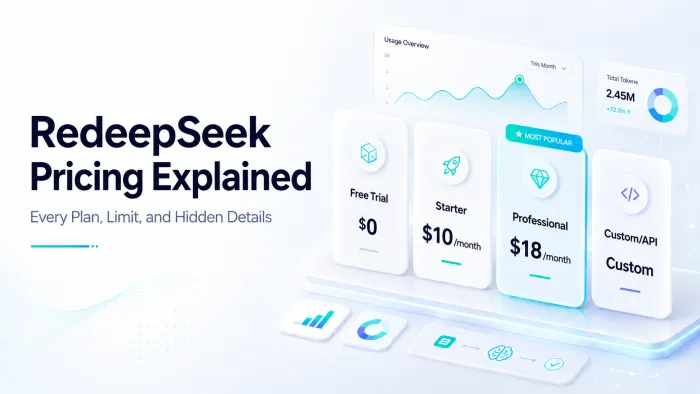
The fastest way to feel the difference between AI search and traditional search is to run the same question through both. Pick a real task you have today - a draft, a comparison, a research summary, a code snippet and try it in RedeepSeek. The Free plan gives you 50 messages per day with no credit card. The Starter plan ($10/month) adds web search, content generation, and 50+ languages. The Professional plan ($18/month) unlocks unlimited messages, document and image analysis, and the code assistant.