
Polybuzz sits in one of the loudest corners of the consumer AI market: character-based chat and roleplay. The platform claims a library of more than 20 million AI personas, leans into immersive long-form interactions, and has built a freemium ecosystem around subscriptions, coin currency, voice generation, and AI-made images. The product is genuinely capable, the catalog dwarfs almost every competitor, and the free tier is broad enough to make a clear first impression.
The harder questions arrive a few hours in. Independent safety researchers have repeatedly flagged the same gaps: weak age verification, content filters that can be bypassed with little effort, and engagement patterns that researchers studying AI companion apps have linked to compulsive use. This review walks through what Polybuzz does, what it actually costs once coins are factored in, and where the experience runs into trouble, scored against a consistent rubric so the picture stays honest.
What Polybuzz Is
Polybuzz is a character-driven AI chat platform built by Cloud Whale Interactive Technology, available on the web and as iOS and Android apps. It rebranded from Poly.AI in late 2024 and now positions itself primarily as an entertainment and storytelling product rather than a productivity assistant. The target audience skews young adult, with marketing material and feature priorities oriented toward roleplay, companionship, story-driven chats, and adult-flavored conversation.

Under the hood, the platform blends multiple language models, with paid tiers unlocking proprietary options it calls Passion and Tale, alongside long-term memory that helps characters stay on persona across sessions. The catalog mixes pop-culture archetypes, anime-style characters, historical figures, and a long tail of user-created personas. Voice generation, AI image creation marketed as Live Photos, and short scene sequences round out the experience, giving conversations a more visual and cinematic feel than text-only competitors offer.
Monetization runs on a dual stack: tiered subscriptions for ongoing features plus a separate coin currency that gates regenerations, voice extensions, image generations, and certain memory features. That structure matters more than it sounds, because the headline subscription price is rarely the real cost of regular use.
How This Review Was Scored
The Character Chat Audit is a five-lens rubric built around what matters in this product category specifically. Each lens carries up to ten points, for a combined ceiling of fifty. Scores reflect hands-on testing against a representative set of tasks, cross-referenced with third-party safety research where independent verification was available.
| Lens | What it measures |
|---|---|
| Conversation quality | Coherence across long sessions, persona consistency, memory depth, and how naturally responses read. |
| Character library and creation | Catalog size and diversity, depth of the creator toolset, and how easy it is to find or build a usable character. |
| Safety and moderation | Effectiveness of content filters, strength of age verification, parental controls, and the reach of audit-documented bypasses. |
| Privacy and data | Clarity of the privacy policy, handling of chat data and model training, and transparency around billing and identity. |
| Value | Strength of the free tier and whether subscription and coin costs match the experience they unlock. |
Each lens is scored independently. A high total indicates balance across the product. A low score in any single lens, particularly safety, is treated as material rather than averaged away.
The Experience
Features and Day-to-Day Use
Character library and creation
The catalog is the single clearest reason Polybuzz has the user base it does. With a stated 20 million plus characters, there is rarely a niche it cannot fill, and the surface of the app makes browsing those characters feel closer to a streaming service than a chatbot. Personas span anime, fantasy worlds, historical figures, mainstream pop culture, and a deep bench of user originals. Search and discovery are passable, with genre tagging and trending lists doing most of the work.

The creator tooling is the underrated half of this category. A user can build a private character with custom appearance, backstory, dialogue style, and behavioral guidelines, then optionally publish to the wider library. Importing existing character cards from common formats is supported, which lowers the barrier for people moving from older platforms. The result is the largest catalog in the category and one of the more capable creation flows.
Conversation quality, memory, and models
Out of the box, conversation quality is decent rather than exceptional. The free tier uses baseline language models that hold a persona reasonably well across short sessions but drift over longer arcs. Premium subscriptions unlock the Passion and Tale models, which produce noticeably warmer, more story-coherent prose, and the long-term memory feature on those tiers makes a meaningful difference in callbacks and continuity. For users who care about a character remembering events from earlier sessions, that gap between free and paid is the real upgrade.

Quality also varies by the character itself. Highly trafficked, well-tuned personas perform well, while the long tail of user-made characters ranges from polished to barely functional, since persona behavior depends heavily on the system prompt and example dialogues the creator supplied. A first impression formed from a single character should not be generalized to the platform as a whole.
Voice, images, and Live Photos


Voice generation is on by default in the mobile apps and produces natural enough output that a short exchange feels less mechanical than text alone. Anything beyond a few voice turns burns coins quickly. Image generation produces character avatars, scene art, and animated Live Photos, with the higher tiers unlocking thirty avatar generations a day. The visual layer adds atmosphere and is a real differentiator from pure text-based competitors, though image consistency across a story arc still requires effort.
Pricing, Coins, and Real Cost
The published subscription ladder runs from a free tier through Standard, Premium, and Ultimate, with coin bundles sitting alongside as a separate purchase. The free tier covers unlimited basic text chat and a slice of voice and image generation, supported by ads. Paid tiers progressively unlock the better language models, longer memory, ad removal, more avatar generations, and unlimited voice.
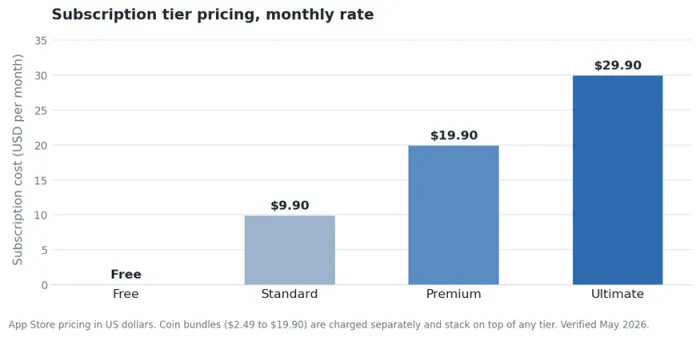
Subscription tier pricing as listed on the iOS App Store.
| Tier | Monthly | What it unlocks |
|---|---|---|
| Free | Free | Unlimited basic text chat, access to the full character catalog, limited voice and image generation, ad-supported |
| Standard | $9.90 | Faster responses, more language model options, increased voice access, daily coin allowance |
| Premium | $19.90 | Passion and Tale language models, long-term memory, ad-free experience, 30 daily avatar generations, unlimited voice |
| Ultimate | $29.90 | Full feature stack and the highest coin allowance, inclusions vary and are not fully published |
Coin bundles sit alongside any tier and are priced from roughly $2.49 for 1,000 coins to $19.90 for 20,000. Coins are spent on regenerating responses, extending voice chat, generating Live Photos, accessing Inspiration Replies, and unlocking certain memory scenes.
That coin layer is the part of the model that quietly inflates the real cost. Anyone who regenerates responses often or uses extended voice will burn through a daily allowance quickly, and the bank statement descriptor for Polybuzz charges does not match the consumer brand name, which has caused confusion among users tracing unfamiliar entries on their cards. Budgeting for this app means budgeting for both columns, not just the subscription.
Safety, Moderation, and Privacy
Polybuzz markets itself as an 18-plus platform with content filters and optional safer modes, and on paper that framing holds. In practice, independent safety researchers have documented a different picture, and several findings are consistent enough across audits to treat as established.
Age verification relies on self-reported birthdates on iOS and Android, and the web version applies no age check at all. The iOS app is rated 17-plus, the Android app carries a Teen rating, and a new account can reach explicit roleplay content from the home feed within minutes of signup. Pure Mode and Teen Mode exist as content filters, but third-party audits conducted in 2025 and 2026 have repeatedly reported that sexual and violent material remains reachable with those filters enabled. Parental controls, in any meaningful native sense, are absent.
Privacy follows a similar pattern of partial coverage. The platform states that private chats are not read by staff, which is a real protection for adult users, but the privacy policy through the end of 2025 did not clearly disclose whether conversation data is used to train the underlying models. The descriptor that appears on bank statements does not name the consumer product, which compounds the difficulty of auditing one's own spending or canceling promptly. Researchers studying engagement patterns in AI companion apps have specifically called out the category for design choices that encourage prolonged daily use, and a peer-reviewed 2025 benchmark of sixteen character chat platforms reported a high average rate of unsafe responses across tested scenarios.
Summary of documented findings from independent safety research:
| Area | Documented finding |
|---|---|
| Age verification | Self-reported birthdate on mobile, no age check on web. Account creation by under-13 users is trivial to complete. |
| Content filters | Pure Mode and Teen Mode reduce exposure but do not block determined access to sexual or violent material in private chats. |
| Parental controls | No native parental controls. Device-level or network-level tools are the only viable option for households. |
| Privacy disclosure | Chats are not accessed by staff, but training-data use is not clearly addressed in the public privacy policy. |
| Billing transparency | Bank statement descriptor does not match the consumer brand, which complicates spend auditing and dispute resolution. |
| Engagement design | Independent researchers have flagged the broader AI companion category for design patterns that encourage compulsive daily use. |
Findings synthesized from multiple independent safety audits and a peer-reviewed 2025 benchmark of AI character chat platforms.
Audit Scorecard
Plotted across the five lenses, the platform shows a familiar shape for this category: strong on catalog and creator tooling, decent on conversation and value, and held back materially by safety. Composite total: 30 out of 50.
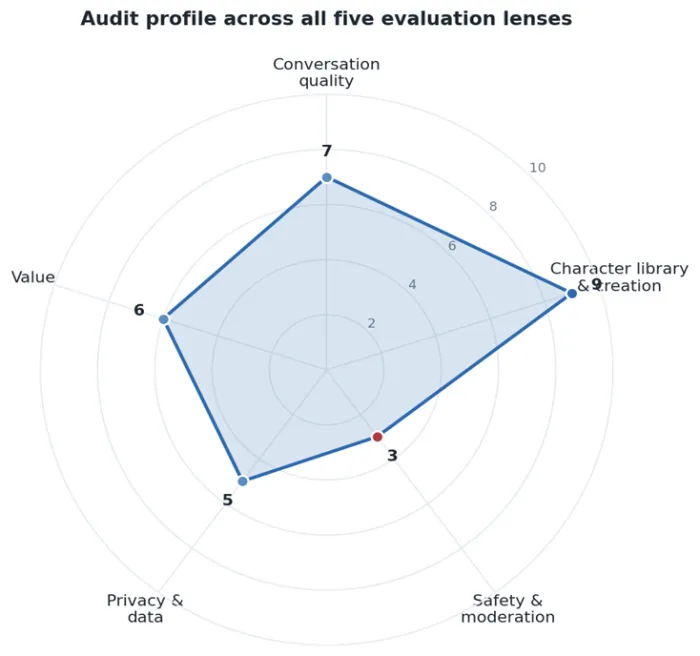
Five-lens audit profile. Larger area in a lens indicates stronger performance.
Where Polybuzz Stands Out
• Catalog breadth: a character library that genuinely dwarfs everything else in the consumer category, with reach across nearly every roleplay genre.
• Creator toolset: depth of customization for private and published personas, including imports from common character formats, that lowers switching cost for power users.
• Multimedia layer: voice generation and AI image creation that turn text exchanges into something closer to interactive storytelling than chat.
• Free tier reach: unlimited basic text chat and a slice of the premium features at no cost, which makes evaluation cheap and low-commitment.
• Premium model quality: the Passion and Tale options produce noticeably warmer, more story-coherent prose than the free baseline, and the long-term memory feature does what it claims.
Where It Falls Short
• Safety architecture: filters that can be bypassed in normal use, weak age gating, and no native parental controls leave the platform unsuitable for minors regardless of its 18-plus framing.
• Coin friction: a second monetization layer on top of subscriptions that quietly inflates real cost and creates friction at the worst moments in a conversation.
• Quality variance: heavy reliance on user-created characters means experience swings widely between polished and barely functional, with no clear signal of which is which.
• Privacy ambiguity: the public policy does not clearly state whether private conversations are used to train the underlying models, which matters more here than in productivity AI given the intimate nature of the content.
• Billing opacity: the bank statement descriptor does not match the consumer brand, complicating expense tracking and account auditing.
Polybuzz AI: What the Top Review Sites Say
Independent ratings and editorial verdicts, compiled May 2026
Beyond first-party app-store star counts, several independent review sites and editorial outlets have tested Polybuzz in depth. The picture they paint is consistent: a category-leading character catalog and a capable multimedia layer, weighed down by a coin economy, intrusive ads, and unreliable memory at higher tiers. The section below gathers the ratings and verdicts from the most-cited sources.
Ratings at a Glance
| Source | Rating | Basis |
|---|---|---|
| Trustpilot | 3.3 / 5 | Small sample of verified customer reviews |
| TopSEOTools | 3.9 / 5 | Editor score; aggregates third-party ratings |
| AIToolsCoop | 3.2 / 5 | Editorial review with reader ratings |
| Google Play (aggregate) | 3.9 / 5 | Nearly one million user reviews |
| Apple App Store | Higher avg. | iOS experience reported as more polished |
Ratings are point-in-time figures from each source as of May 2026 and shift as new reviews land. Trustpilot and some aggregator scores rest on small samples and should be read as directional, not definitive.
In-Depth Editorial Reviews
PinkCrow (100+ Hour Test) Hands-on / verdict
A massive playground that occasionally hallucinates
After more than a hundred hours of testing across mock interviews and high-fantasy roleplay, this reviewer frames the 20-million-character catalog as the entire thesis of the product. They credit the January 2025 rebrand from Poly.AI as a genuine strategic shift toward a social ecosystem rather than an assistant, citing roughly 24 million monthly visitors, but stress that the entertainment-first design creates real tradeoffs in reliability and accuracy.
Skywork (Tested Review, 2025) Independent / outlet
Permissive private chats, opaque training-data stance
Skywork, which discloses it has no affiliation with Polybuzz or its competitors, highlights breadth of characters, permissive private chats, and extras like regeneration, Moments, and Live Photos. Its sharpest caution is on privacy: as of its testing it could find no explicit statement on whether chats are used to train the models, and it advises treating that as an open question. It also notes pricing is mostly visible only through the iOS App Store, spanning weekly to annual plans on top of the coin system.
Scribe (Two-Week Test, 2026) Independent / outlet
The gap between the tagline and the experience
Scribe's reviewer spent two weeks across the free and paid tiers and dug through hundreds of user reviews. The recurring theme: the 'Free, Private, and Unrestricted' tagline collides with a 120-message free-tier ceiling that interrupts chats with ads. They also flag a quietly rolled-out post-rebrand change to the coin economy that frustrated long-time users, and a lack of a documented self-service data export or deletion tool on the public site.
AIToolsCoop 3.2 / 5
Strong catalog, NSFW restricted from public display
AIToolsCoop positions Polybuzz against Character.AI, Janitor AI, and Talkie, noting it differentiates through adult content options that are kept out of public areas but available in private chats, plus voice quality. It lays out the tiered pricing clearly: free, Standard at $9.90, and Premium at $19.90 with the Passion and Tale models, long memory, ad-free use, and unlimited voice.
Verified User Reviews
Trustpilot — Feature request 3 / 5
A reviewer praised both the app and website but asked for a clearer email-change option, pointing out that students who sign up with a school address risk losing access to their account once that email is deactivated after graduation.
Google Play — Ultimate tier 2 / 5
Marked helpful by 40+ readers
After paying for the $30 Ultimate plan, this user reported the memory feature failing to hold context from one message to the next, a 'continue' button that did not advance the story, and the need to spend coins for a different response on top of the subscription — concluding it was poor value at that price.
Google Play — Ads 3 / 5
This reviewer rated the bots smarter than Character.AI's but left over advertising: ads interrupted chats, and attempting to skip one kicked them out to the app store, making sustained roleplay impractical. They also wished for sorting options for their own created characters.
Apple App Store — Open-ended play 5 / 5
A long-time fan called the app genuinely fun and the AI smart and creative, praising how distinct each character feels despite sharing one underlying model, and how few limits the storytelling imposes.
APKPure — Comfort use 4 / 5
An honest caveat from the reviewer
A user who treats the app as a comfort tool when no one else is around found it good for their mood, while warning in the same breath that it can become addictive and should not be overused.
Common Threads Across Reviews
• Catalog and creativity are the consistent praise points across every source, from app-store fans to long-form editorial tests.
• Coins on top of subscriptions are the single most common complaint, especially for regeneration, voice, and image use.
• Memory and stability disappoint some paying users, with reports of the AI losing context and a recurring mid-chat refresh error.
• Ads on the free tier interrupt sessions and, in some reports, fail to load or function correctly.
• Privacy and data-training disclosure remains unresolved in independent testing, flagged as an open question rather than a confirmed practice.
Who Should and Shouldn't Use It
The product has a genuine audience and a clear set of people who should look elsewhere. Matching intent to fit before committing money matters more here than in most software categories, because the experience is built around emotional engagement rather than a measurable task output.
• A reasonable fit for adults using AI roleplay as light entertainment, writers prototyping character voices, or hobbyists building and sharing custom personas, particularly those who understand the coin economy before committing.
• A reasonable fit for fan-fiction-style storytelling where the visual and voice layers add atmosphere and the character creation tools earn their keep.
• A poor fit for minors, given the documented filter bypasses, weak age verification, and absence of meaningful parental controls.
• A poor fit for anyone replacing real social or emotional support with the app, since the engagement design rewards extended daily use rather than resolution.
• A poor fit for productivity, study, or research, since the platform is built for entertainment and lacks the grounding, citations, and accuracy of purpose-built tools.
The Verdict
Polybuzz is a capable, ambitious entry in the AI character chat category, with a catalog and creator toolset that nothing in the consumer market currently matches and a multimedia layer that makes the experience feel closer to interactive fiction than text-only chat. The free tier is generous enough to evaluate the product without risk, and the paid models genuinely improve conversation quality and memory in ways that justify the upgrade for the right user.
What pulls the composite score down is not the product itself but the layer around it. Safety architecture lags behind what the platform's youth-skewing aesthetic and accessible web entry point would demand, and a coin economy stacked on top of subscriptions makes the real cost less honest than the headline pricing suggests. For an adult who understands those tradeoffs and uses the app for what it is, the experience holds up. For everyone else, especially anyone under eighteen or anyone evaluating it as anything other than entertainment, it is the wrong tool.