
Snapshot Verdict
For readers short on time, the table below distills the editorial position taken across the rest of this review.
| SNAPSHOT VERDICT | Polybuzz AI at a glance |
|---|---|
| Category | AI character chat platform with roleplay, companionship, and creative storytelling functions |
| Best suited for | Casual chat, interactive fiction, character roleplay, writer brainstorming, light language practice |
| Less suited for | Productivity tasks, factual research, professional workflows, anything requiring deterministic output |
| Standout feature | Library scale (20M plus characters) combined with persistent in-character memory across sessions |
| Biggest trade-off | Repetition risk in longer chats and ongoing debates around content moderation and AI companion ethics |
| Pricing model | Freemium core, three paid tiers from 9.90 to 29.90 USD monthly, optional coin packs for premium actions |
| Editorial rating | 3.1 out of 5 |

Origins of the Personality-Driven Chat Shift
A quiet shift is underway inside AI chat platforms, and it has little to do with productivity. The focus is moving away from answers and toward interaction. Rather than asking a chatbot to explain a topic or complete a task, audiences are increasingly choosing to spend time inside conversations that feel ongoing, personal, and often story-driven.
Polybuzz AI sits directly inside this shift. It is not designed around efficiency or utility in the traditional sense. Its core appeal lies in something less structured: the ability to talk to characters that behave like individuals. These are not static bots with predictable replies. They are designed personalities with tone, memory, and narrative context, capable of sustaining conversations that evolve over time.
What makes Polybuzz notable is not just the technology behind it, but the environment it creates. AI stops feeling like a tool and starts behaving more like a participant.
This review examines Polybuzz from that angle. Not just as another chatbot, but as part of a broader move toward AI-driven interaction spaces where personality, storytelling, and user intent are tightly connected.
What Polybuzz Actually Is
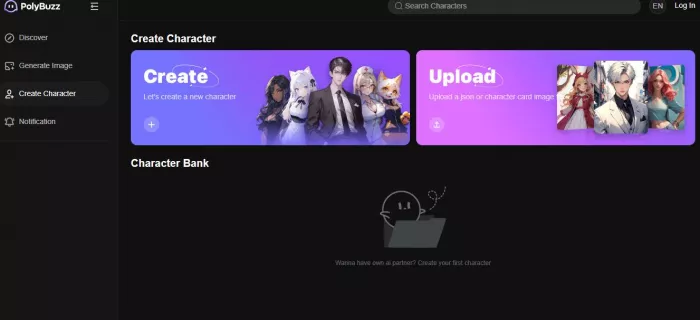
At its core, Polybuzz is an AI-driven social platform where conversations revolve around characters rather than simple prompts. Instead of opening a blank chat window, audiences browse a library of personalities. Each character has a profile that contains personality traits, a story background, descriptive tags, and often an avatar image. Any character in the library can be opened for an immediate conversation.
The platform operates across web browsers, mobile apps, and desktop environments, which keeps access friction low across devices. The guiding idea is that conversations should feel like interactions with individuals rather than machines. Character traits, speech styles, and narrative context all shape how the AI responds.
Three quick examples of how character framing changes tone
• A historical character tends to speak formally and reference real events.
• An anime-styled character may respond dramatically and emotionally.
• A fictional companion can behave like a friend, mentor, or confidant.
The combined effect is a narrative environment where conversations can evolve and accumulate context, not just produce one-shot answers.
How the Platform Works
Although Polybuzz appears simple on the surface, several AI components run behind the scenes. The cleanest way to understand the platform is to look at it as a three-phase loop: an identity setup phase, a live generation phase, and a continuity layer that runs across messages.
| Phase | Layer | What happens inside the system |
|---|---|---|
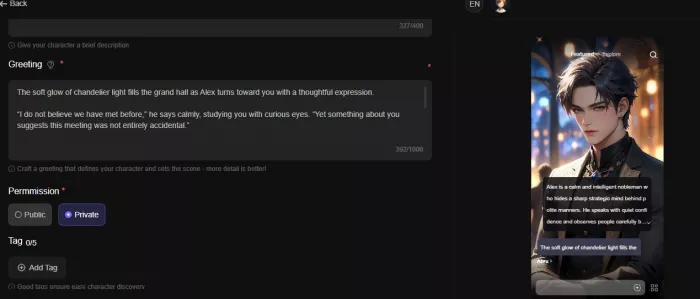
| 01 | Identity setup | A character is selected from the library or constructed from scratch using name, personality traits, background story, conversation style, and an avatar that can be uploaded or AI-generated |
| 02 | Live generation | Each user message is combined with the character profile and conversation history before the model generates a reply, so the response is shaped by personality rather than acting as a generic answer |
| 03 | Continuity layer | A memory system carries forward names, earlier story beats, shared facts, emotional tone, and the evolving relationship, with extended memory available on paid tiers |
Why this loop matters in extended chats
Most generic chatbots treat each message as an isolated request. The three-phase loop is what allows Polybuzz characters to keep behaving like a defined personality across a long session. Tone, history, and relationship state all feed back into every reply, which is why a serious fantasy knight keeps replying formally on message fifty just as it did on message one, and why a casual best-friend persona stays light across an entire evening.
Capability Matrix at a Glance
The matrix below captures the main feature surface of the platform without the marketing layer. These are the practical capabilities available to users across the free and paid tiers.
| Capability | What it enables |
|---|---|
| AI character conversations | Real-time chat with millions of AI personalities across genres and franchises |
| Custom character creation | Original characters with defined personality, story background, and visual identity |
| Voice interaction | Selected characters respond in voice as well as text |
| Image generation | AI-generated avatars and scene images tied to conversation context |
| Roleplay environments | Characters can participate in extended narrative scenarios |
| Long conversation memory | Persistent context across messages, with stronger memory on paid tiers |
In combination, these features push Polybuzz beyond the standard chatbot definition and into a hybrid space that overlaps with storytelling tools and social platforms.
Inside the Character Ecosystem
One of the platform's defining features is the scale of its character ecosystem. Polybuzz hosts millions of personalities across many categories, and the library continues to expand because users are not just consumers, they are also authors. Anyone can publish a new character, which means the catalogue grows organically as creators add original personas, fan recreations, and themed companions.
Official platform messaging highlights libraries that span thousands of anime series and movie titles, and the broader catalogue reaches more than twenty million characters across categories.
| Category | Representative examples |
|---|---|
| Anime and manga | Characters drawn from popular anime universes and long-running manga series |
| Movies and television | Film characters, recurring TV personalities, and reimagined classics |
| Gaming | Video game heroes, villains, and supporting cast from major franchises |
| Music and celebrities | AI versions of recording artists and public figures |
| Original creations | Community-built personalities ranging from companions to story characters |
| Companions | AI friends, mentors, and romantic personas designed for ongoing dialogue |
This community-driven model is the main reason the catalogue has scaled so quickly. It also explains the variability in quality: some characters are richly written and stay consistent across long chats, while others rely on thin prompts and tend to break character once the conversation moves past the obvious topics.
Usage & Editorial Assessment
The technology is the easier part of the Polybuzz story. The more interesting part is how the audience actually uses it, which rarely resembles standard chatbot behavior. Four use patterns show up repeatedly across community discussion and review coverage.
Pattern one: interactive fiction and roleplay
Many audiences treat Polybuzz as interactive fiction. Roleplay with movie or anime characters is common, as is open-ended storytelling where a user joins a fantasy quest, debates a villain, or talks with a historical figure through a fictional lens.
Pattern two: dialogue brainstorming for writers
Writers often use AI characters to test how a persona might respond to a question or a scene beat. Instead of guessing how a character should sound on the page, the writer asks the AI version and uses the reply as a draft, a counterpoint, or a starting point for revision.
Pattern three: emotional companionship
A subset of audiences treats AI characters as supportive listeners. Polybuzz explicitly markets companion-style AI girlfriends, AI friends, and mentor personas designed for ongoing personal conversation, and this is one of the more debated parts of the broader category.
Pattern four: low-pressure language practice
A more practical pattern is language learning. Chatting with AI characters can simulate everyday conversations in a target language, with the added benefit of a personality context that keeps the practice from feeling mechanical.
Editorial Verdict on Strengths and Trade-Offs
Polybuzz offers a distinct set of advantages, and it shares a familiar set of trade-offs with the rest of the AI character category. The table below reads as an editorial conclusion rather than a feature list.
| Strengths | Trade-offs |
|---|---|
| Massive, continuously growing character library | Content moderation policies remain a contested topic |
| Full custom character creation with personality and visuals | Long conversations can settle into repetitive patterns |
| Strong immersion in roleplay and narrative scenarios | Response accuracy and tone consistency vary by character |
| Cross-platform access on web, mobile, and desktop | Most depth, memory, and quality sit behind paid tiers |
| Community-driven ecosystem keeps content fresh | Ongoing ethical questions around AI companion design |
Large community forums that discuss Polybuzz frequently surface debates about content moderation policy and restrictions on certain types of roleplay. Those conversations are not unique to this platform, but they show up consistently enough to deserve mention here.
Pricing, Market & Outlook
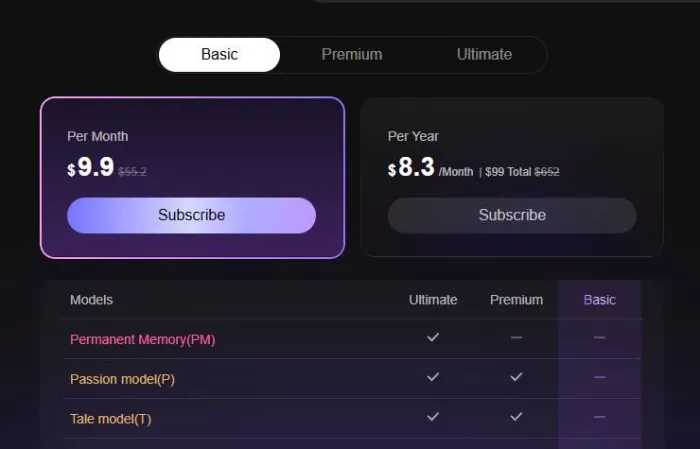
Polybuzz uses a freemium model. The core experience is accessible without payment, while advanced capabilities, including improved AI models, longer memory, and enhanced chat features, are unlocked through paid subscriptions. The subscription structure below appears in the official App Store in-app purchase listing.
Recurring subscription tiers
| Tier | Monthly price | What is included |
|---|---|---|
| Free | 0 USD | Basic AI conversations, full character browsing, and limited interaction features |
| Poly Standard | 9.90 USD | Ad-free chat, improved AI responses, and extended interaction features |
| Poly Premium | 19.90 USD | Advanced AI capabilities, longer memory window, and additional customization |
| Poly Ultimate | 29.90 USD | Full feature access, highest limits, priority processing across all interactions |


Coin packs for one-off premium actions
Coins act as micro-credits for specific premium actions such as regenerating responses, extending voice chat sessions, or unlocking special interactions. They sit alongside the subscriptions rather than replacing them.
| Coin pack | Price |
|---|---|
| 1,000 coins | 2.49 USD |
| 3,000 coins | 4.99 USD |
| 8,000 coins | 9.99 USD |
| 20,000 coins | 19.90 USD |
The pricing structure rewards regular users: the standard tier removes ads and unlocks better responses, while premium and ultimate primarily extend memory and processing limits for heavier roleplay sessions.
Field Test Notes and Reviewer Scorecard
After hands-on testing of Polybuzz AI alongside a review of widely cited community feedback, a clear pattern emerged: the platform shines for entertainment and roleplay, not for productivity. Engagement is high in early sessions, but long-term value depends heavily on how the platform is used and which characters are chosen.
| Evaluation factor | Score | Editorial observation |
|---|---|---|
| Engagement quality | 4.2 / 5 | Highly interactive and immersive in the first sessions |
| Creative range | 4.0 / 5 | Strong character-based storytelling and roleplay scope |
| Practical usefulness | 2.4 / 5 | Limited value outside of entertainment contexts |
| Long-session consistency | 2.8 / 5 | Repetition tends to set in across extended chats |
| Trust and safety | 3.0 / 5 | Active community debate around moderation and ethics |
| Overall verdict | 3.1 / 5 | Fun for casual use, not for serious or repeatable tasks |
The scorecard reflects the typical curve observed in extended testing: strong first impressions, healthy creative range, and a steady drop on practical usefulness and long-session consistency once the novelty fades.
Competitive Positioning Against Rival Platforms
Polybuzz operates in a crowded category alongside several other AI character platforms. The comparison below highlights where it leads the pack and where rivals stay competitive.
| Platform | Character library | Roleplay focus | Custom characters | Voice support |
|---|---|---|---|---|
| Polybuzz AI | 20M plus characters | Strong | Yes | Yes |
| Character AI | Large | Strong | Yes | Limited |
| Chai AI | Moderate | Moderate | Yes | Limited |
| Janitor AI | Smaller | Strong | Yes | Limited |
Polybuzz differentiates itself primarily through library scale and multimedia interaction. The depth of voice support across characters is also a meaningful point of separation, since most rivals still treat voice as a limited add-on rather than a first-class feature.
Broader Significance in the AI Chat Landscape
AI chat platforms are evolving from productivity tools into social environments, and Polybuzz represents a clear step in that direction. Instead of asking a chatbot for answers, audiences build relationships with digital personalities. For some, the platform functions as a creative sandbox. For others, it is entertainment, companionship, or storytelling. The motivations vary, but the underlying behavior is consistent: AI is being treated as a participant in an experience rather than a tool that returns an output.
As underlying models continue to improve, platforms like Polybuzz may become some of the more interesting venues where human imagination and artificial intelligence intersect, especially as memory, voice, and visual generation continue to merge inside a single interface.
Closing Analysis
After extended time inside Polybuzz AI, the experience feels engaging at first and then settles into a more limited pattern. The platform delivers well on interactive, character-based conversations, but it struggles to offer depth, consistency, or real utility beyond that space. Over time, it reads more clearly as an entertainment-driven AI rather than a tool that can be relied on for sustained or productive use.
That positioning is not a flaw on its own. For audiences that want a creative sandbox, a roleplay environment, or a casual companion experience, Polybuzz delivers what the category promises. For audiences expecting a productivity assistant or a research tool, it is the wrong product. The 3.1 out of 5 rating reflects this gap between high entertainment value and limited practical utility.
Final editorial rating: 3.1 / 5