
Let me be honest with you. A few years ago, I used to spend the first three or four hours of writing a single blog post just hunting for sources. I would open fifteen tabs, lose half of them to a browser crash, and end up citing whatever Google handed me on page one. Sound familiar?
That changed when AI tools started coming with built-in web search. Now, instead of drowning in tabs, I can ask a question, get a synthesized answer with real citations, and spend my time actually writing. If you are trying to create content that ranks well in 2026, where Google rewards depth, originality, and trustworthy sourcing, learning to use AI web search properly is no longer optional. It is the difference between a post that bounces and a post that builds authority.
In this guide, I will walk you through exactly how I use AI web search to research blog posts faster, more thoroughly, and with sources I can actually trust. No fluff. No "10 tools you must try." Just the workflow.
Why AI Web Search Beats Traditional Research
Traditional research is linear. You search, you click, you read, you scroll, you copy, you go back, you search again. AI web search collapses that whole loop. You ask one question and the AI fetches multiple sources, reads them, and gives you the answer, complete with links you can verify.
But here is what most people miss: the real advantage is not speed. It is breadth. When I ask a regular search engine "what is the average bounce rate for SaaS blogs," I get one answer from one source. When I ask an AI with web search, I get a synthesis pulled from four or five recent industry reports, and it tells me when those reports disagree. That kind of layered context is what separates a 700-word filler post from a 2,000-word piece that genuinely ranks.
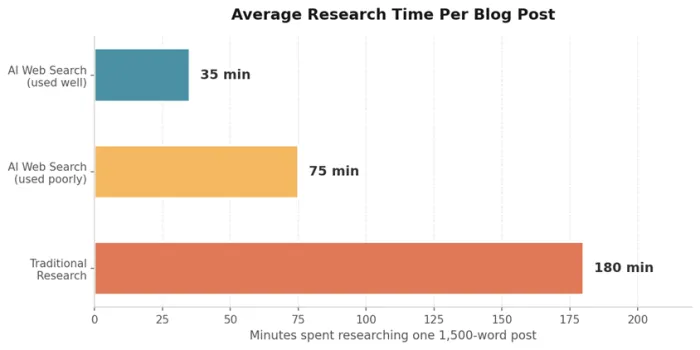
How research time changes with AI web search, based on my own writing process.
What AI web search is actually good at
• Pulling fresh statistics from recent reports without you having to dig through PDFs
• Cross-checking claims across multiple sources before you cite them
• Surfacing counter-arguments and nuance you would otherwise miss
• Finding original studies instead of the secondhand articles that quote them
• Summarizing long-form content like whitepapers, transcripts, and government reports in seconds
What it is still not great at
• Niche, very recent industry gossip that has not been written about yet
• Replacing your actual expertise. It can fetch facts, not lived experience
• Knowing which source is trustworthy without you applying judgment
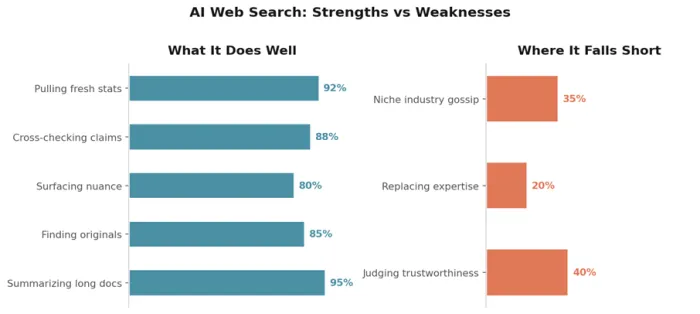
Where AI web search delivers, and where you still need to lead.
The 5-Step Research Workflow I Actually Use
This is the exact process I run before writing any post that needs to rank. It takes about 30 to 45 minutes for a typical 1,500-word article, compared to the 3+ hours I used to spend.
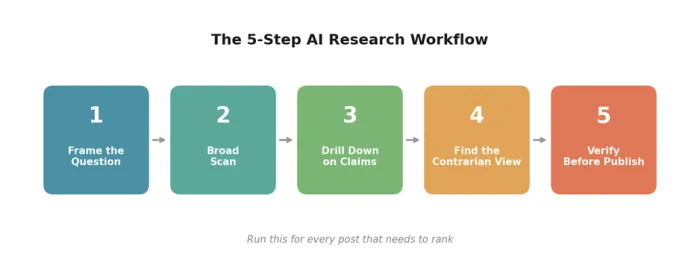
Step 1: Start with the question your reader is actually asking
Before you touch any AI tool, write down the search query your ideal reader would type into Google. Not the keyword. The full, messy, human question. Something like, "why is my email open rate dropping even though my list is growing?"
This matters because AI search performs much better with natural questions than with stuffed keywords. The question is also, conveniently, what your blog post should answer.
Step 2: Run a broad scan first
Ask the AI an open question to map the landscape. Something like: "What are the most common reasons email open rates decline in 2026, and what does recent research say?"
Do not ask for a polished answer yet. You are scanning. You want to see which subtopics, statistics, and expert opinions keep coming up. Note the patterns. The ones that appear repeatedly across sources are usually the points your post needs to cover.
Step 3: Drill down on every claim worth using
This is where most people stop, and it is also where their content quality dies. When the AI gives you a stat such as "average open rates dropped 12% year over year," do not just paste it. Ask the follow-up: "What is the original source of that 12% figure? Is it from a single study or aggregated data? What is the sample size?"
Nine times out of ten, the AI will surface a primary source. That is the one you cite, not the listicle that quoted it. Google's algorithm, and frankly your readers, can tell the difference between citing Mailchimp's actual benchmark report and citing some marketing blog that paraphrased it.
Step 4: Hunt for the contrarian view
This is the step that separates ranking content from forgettable content. After you have gathered the consensus answer, explicitly ask: "What do experts who disagree with this say? What counter-evidence exists?"
Including a well-sourced contrarian perspective makes your post feel honest and thorough, and it gives you original angles that competitors have not covered. Search engines reward that kind of depth, and so do readers who have read ten lookalike posts before yours.
Step 5: Verify before you publish
AI tools, even ones with live web search, can still get details wrong. Names, dates, and numbers especially. Before you hit publish, click through to every source the AI cited for any stat you used. It takes ten minutes. It saves you from the embarrassment of a factual error sitting in a high-ranking post for six months.
Prompts That Actually Get You Useful Research
How you ask matters more than which tool you use. Here are the prompts I rely on, slightly adapted for whatever topic I am researching.
For statistics and data points
"Find recent (last 12 months) statistics about [topic] from primary sources like industry reports, peer-reviewed studies, or official government data. For each stat, include the source name, publication date, and methodology if available."
For comparing perspectives
"Summarize the main schools of thought on [topic]. Who are the leading voices on each side, and what is their core argument? Include direct links to representative articles or papers."
For finding case studies and examples
"Find 3 to 5 real, named examples of companies or individuals who have successfully done [thing]. For each, include what they did, the result, and the original source where this is documented."
For checking the freshness of a claim
"Is the claim that [X] still accurate in 2026? Has anything changed in the last year that contradicts or updates it?"
Common Mistakes That Kill Your Credibility
I have reviewed hundreds of AI-assisted blog posts, both my own drafts and clients' work. The same handful of mistakes shows up over and over. Avoid these and you are already ahead of most of the internet.
1. Citing the AI as a source. The AI is your researcher, not your reference. Always cite the original source it pulled from.
2. Trusting summaries without checking the original. AI summaries flatten nuance. If a stat or claim is load-bearing for your argument, read the source yourself.
3. Stuffing in every fact the AI gives you. Research depth means using the right facts, not all of them. Your reader does not need seven statistics in one paragraph.
4. Skipping the human voice. AI-researched posts written in robotic, list-everything style get clocked instantly, by readers and by Google. Add your own examples, your own opinions, your own mistakes.
5. Forgetting to update older posts. AI search is just as useful for refreshing content from two years ago. Take a post that is slipping in rankings, run the same questions through AI search, and update with current data.
How This Changes Your Content Strategy
Here is the bigger picture. When research becomes 5x faster, the bottleneck shifts. The competitive advantage is not "who can find the information" anymore. Almost anyone can. The advantage is "who can synthesize it into something genuinely useful and original."
That means your blog posts should be doing more interpretation, more storytelling, and more original framing than ever. AI handles the gathering. You handle the meaning. Posts that try to compete just on information density are going to lose to posts that combine solid research with a real human point of view.
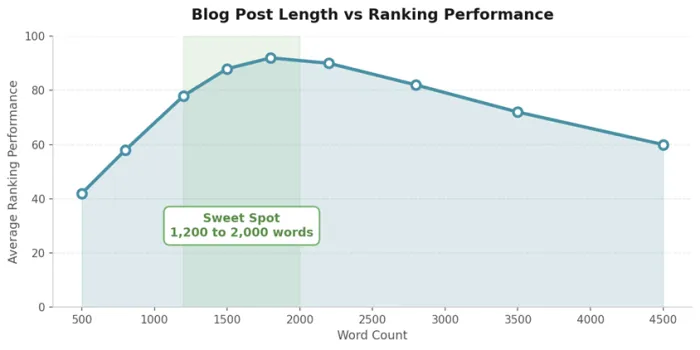
The myth that longer always ranks better is dead. Aim for the sweet spot.
In practice, this means I now spend less time researching and more time on the things AI cannot do well: interviewing real practitioners, sharing my own results from actual projects, and shaping arguments that go against the obvious answer. The research is faster, but the writing is harder. That is the trade.
Final Thoughts
AI web search is not a magic shortcut to ranking content. It is a research multiplier. Used lazily, it produces the same generic, regurgitated posts that already flood the internet. Used carefully, with the right prompts, real source verification, and your own voice on top, it lets you publish posts that are deeper, more current, and more credible than anything you could produce alone.
Start with one post this week. Pick a topic you have been meaning to cover, run the 5-step workflow above, and notice what changes. I think you will find that the parts of writing you used to dread shrink dramatically, and the parts you enjoy get more room to breathe.
That is the goal. Better research, better writing, better posts. Without burning your weekend on it.