There is an old human habit of mistaking a good explanation for a good decision. It worked long before computers arrived, and it works even better now that the person doing the explaining can answer in seconds, never hesitates, knows several lifetimes of technical analysis, and can make an ordinary trading idea sound as though it came out of a research department with marble floors.
Modern AI models know an extraordinary amount about trading. They know support and resistance, momentum, moving averages, RSI, MACD, Bollinger Bands, liquidity sweeps, market structure, Smart Money Concepts, Wyckoff, order blocks and most of the mathematical furniture traders have dragged into charts over the last fifty years. That sounds useful, and it is useful, but there is an awkward detail hiding underneath it: the same collection of knowledge can often build an excellent argument for buying and an equally respectable argument for selling.
I decided to test that problem rather than merely complain about it. The chart was AUDNZD on the four-hour timeframe, stopped in TradingView Replay around 1.2027. The first question was deliberately simple: looking only at the price chart, would you buy, sell or wait?
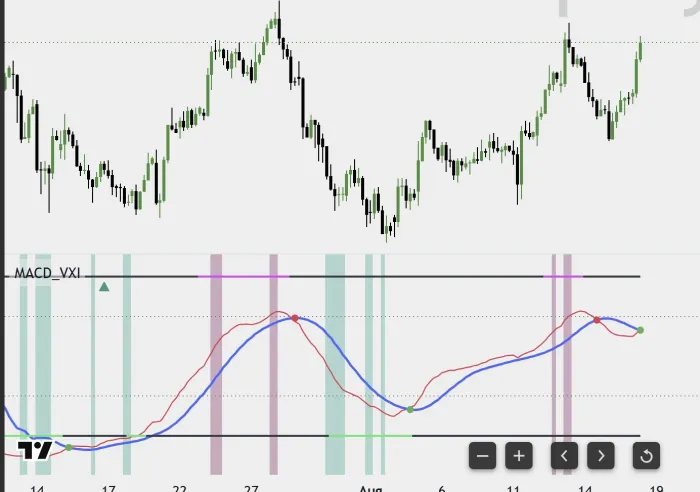
The AI chose to wait, but with a bullish bias. Its reasoning was sensible enough. Price had pulled back into the 1.2020–1.2030 area after a strong move higher, and that region had already behaved as an area of reaction. Selling after the decline looked late, while buying immediately lacked confirmation. The proposed plan was therefore to wait for price to recover above roughly 1.2040–1.2045, then consider a long position with protection around 1.2000 and an initial target near 1.2075, followed by 1.2090–1.2100.
There was nothing miraculous about that analysis. That was precisely why it was interesting. It was cautious, coherent and quite believable.
Then I showed the AI the same market again, but this time I added a custom indicator and supplied its Pine Script source code so there would be no mystery about what was being displayed. The indicator contained a normalized MACD, signal line, RSI, PSO logic, Bollinger calculations, reversal conditions and several threshold zones. In other words, I did what traders are constantly told to do: I supplied more information.
More information should have made the decision better. Instead, it changed the story.
The AI now focused on the bearish MACD crossover, the previous overbought condition and the additional momentum information supplied by the indicator. The earlier WAIT followed by a possible BUY became WAIT followed by a possible SELL. A rejection around 1.2040–1.2050 suddenly looked attractive as a short entry, while a move back toward 1.2060–1.2070 would invalidate the bearish interpretation.
This was the interesting part: both explanations were good.
The first analysis said price had returned to support after a pullback and selling there offered poor timing. The second said momentum had rolled over and additional indicators were warning that buyers were losing control. Nothing absurd had been said in either case, and neither answer sounded like a machine throwing darts at a board. Each answer had structure, terminology and enough technical reasoning to make a trader feel that some serious work had taken place.
Yet the chart had not changed. I had simply changed the context around it.
Then TradingView Replay was allowed to continue. Price moved higher, passed the area where the original analysis wanted confirmation for a long position and traded above the first projected objective. The original interpretation of the plain chart turned out to be closer to what happened, while the supposedly richer analysis had managed to talk itself into the opposite direction.
That does not prove that bare charts are superior, that MACD is useless, or that one AUDNZD trade has revealed the secret of the market. One chart proves almost nothing about trading performance. What it does demonstrate rather neatly is how easily a capable AI model can reorganize the same market into a different story once it receives another set of concepts to work with.
This is where AI trading becomes more complicated than the sales pitch suggests. A language model is exceptionally good at connecting evidence into a coherent narrative. Trading happens to provide an almost unlimited warehouse of evidence. A resistance level can support a short thesis while a liquidity sweep supports a long thesis. Weak momentum can warn against buying while mean reversion can argue that weakness has already gone too far. A trader can add one more indicator to settle the argument and instead provide the model with three new arguments.
The danger is not that AI knows too little technical analysis. The danger may be that it knows too much of it.
A model does not need to invent nonsense in order to make a bad decision. It can construct a perfectly respectable losing trade using ideas found in thousands of books, courses, papers and trading discussions. Give it Smart Money Concepts and it can explain the liquidity. Give it momentum tools and it can explain exhaustion. Give it market structure and it can explain the break. Give it enough material and eventually it has the intellectual equivalent of a well-stocked bar: whatever mood the market happens to be in, there is something suitable on the shelf.
That matters far more once AI moves from answering questions to placing orders automatically. Asking a model for an opinion costs almost nothing. A bad answer can be challenged, ignored or laughed at. An autonomous agent connected directly to a trading account does not need to win the argument; it only needs permission to press Buy and Sell. At that point a sequence of beautifully reasoned decisions can turn into a wedding band marching noisily across the entire deposit.
The most dangerous version would not even look stupid. Every position could arrive with an explanation, every stop could be justified by changing structure, and every reversal could be supported by a fresh technical observation. By Friday the agent might produce a magnificent report explaining why everything that happened during the week made perfect sense. The broker would probably agree. Brokers tend to appreciate activity.
There is another way to approach the problem. Traders who still want external trading ideas can use a portfolio of experienced signal providers whose forecasts remain visible in Telegram history and can therefore be checked after the fact. Their calls are not magically correct either, but at least there is a record. A trader can scroll backward, compare entries with later price action and decide whether the source deserves attention without relying on a newly generated explanation for yesterday.
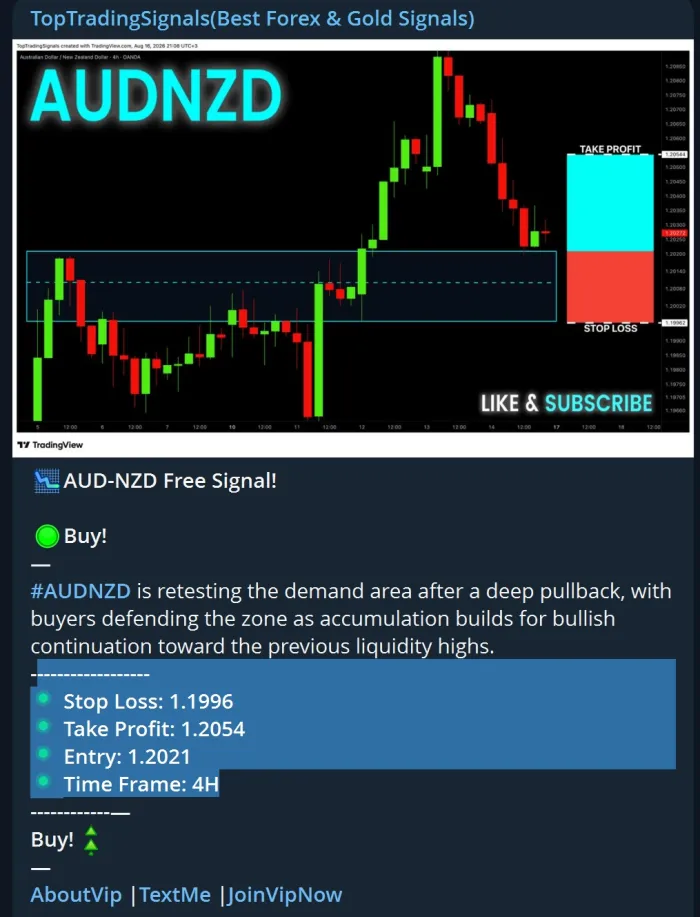
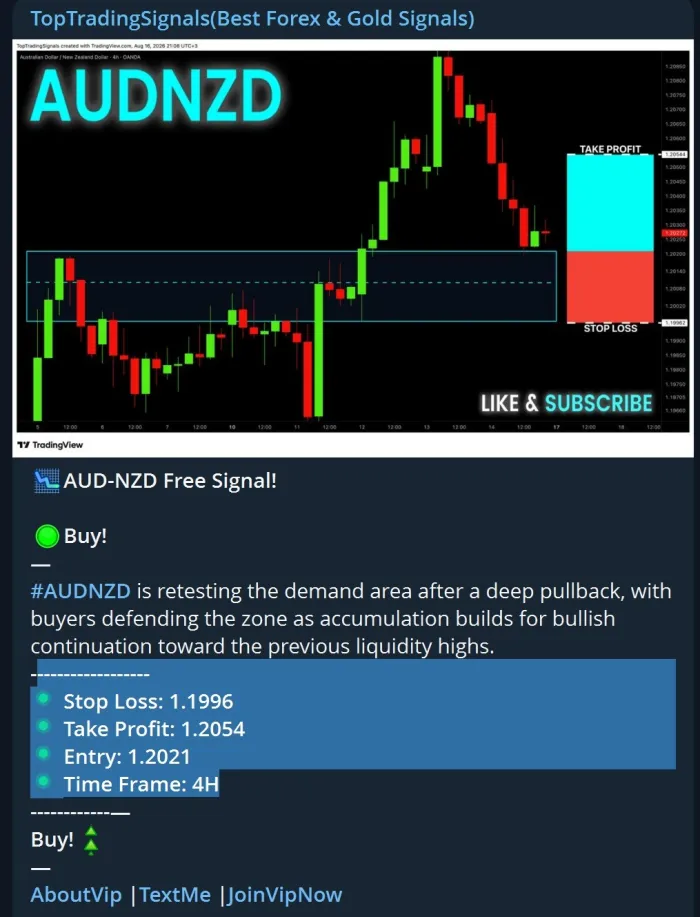
The AUDNZD trade used in this experiment came from exactly such a Telegram signal. It called for a BUY around 1.2021, with a Stop Loss at 1.1996 and Take Profit at 1.2054. That signal existed before this experiment began, so there was no opportunity to move the goalposts after seeing what price did. The market later traded through the stated target.
The amusing part is that the AI's first reading of the plain chart was broadly compatible with that bullish idea. It took an additional layer of sophisticated-looking information to persuade the same model to become bearish. More analysis did not rescue the decision; it simply gave the wrong decision better clothes.
This is why verifiable signal history has one advantage that even the most eloquent AI cannot manufacture afterward. A published trade either existed before the move or it did not. Its entry, stop and target can be checked. A beautiful explanation written after price has moved is literature, and sometimes very good literature, but it is not a trading record.
The practical problem then becomes much less glamorous and much more useful: once reliable signal sources have been selected, somebody still has to monitor Telegram, recognize the symbol and direction, extract the entry, Stop Loss and Take Profit, and send the order to the correct trading account without spending the entire day staring at a phone.
This is where AlgoWay fits into the process. AlgoWay is a trading automation platform that can receive signals from Telegram, TradingView and other sources, interpret the trading instructions and route them to execution platforms including MetaTrader 5, cTrader, brokers and cryptocurrency exchanges. Instead of asking AI to invent the trade and then trust its own explanation, the decision can come from a source with a visible history while automation handles the dull machinery between the signal and the order.
That strikes me as a considerably safer job for artificial intelligence. Let it read, normalize, translate and execute what can be checked. Giving it the entire deposit and asking it to discover the truth about the market in real time may eventually work too, but until then it is worth remembering one uncomfortable fact: AI is already extremely good at explaining why a trade makes sense, including the trade that makes no sense at all.