Quick Verdict
Three-Zone Trust Map
Short answer: You can rely on AI for some business decisions and absolutely cannot rely on it for others. The honest framework is to split every decision into three zones based on the cost of being wrong. AI is excellent at pattern-heavy, data-rich, high-volume decisions. It is useful but needs human verification on strategic decisions. It is dangerous on high-stakes, one-shot, or ethically loaded decisions.
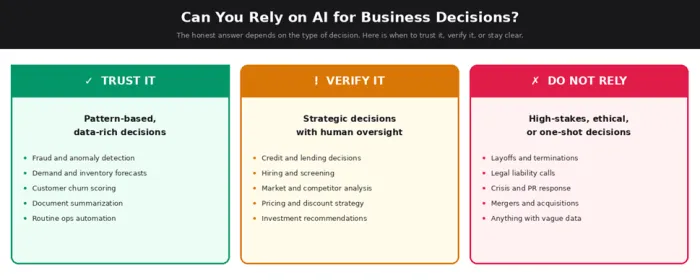
The three-zone trust map. Place every business decision in one of these zones before deciding how much AI to use.
AI Adoption Numbers That Define 2026
Before anyone can answer whether AI belongs in business decisions, the numbers are worth knowing. The state of AI adoption in 2026 is two stories at once: rapid spread, and equally rapid failure. Both are true.
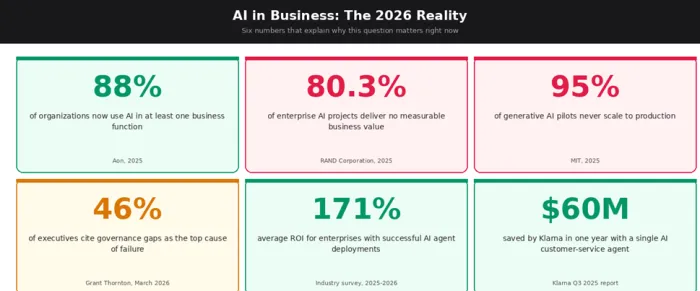
AI is now a standard part of how organizations operate. 88 percent of organizations report using AI in at least one business function, up from 78 percent the previous year.
But adoption does not equal success. RAND Corporation's 2025 enterprise AI analysis found that 80.3 percent of enterprise AI projects deliver no measurable business value. MIT research showed 95 percent of generative AI pilots never make it from demo to production.
The leading cause is not the technology. It is governance. Grant Thornton's March 2026 survey of 950 business leaders found that 46 percent cite governance gaps as the top cause of AI underperformance, and 84 percent of failures are driven by leadership issues.
AI also climbed to the second-highest position on the Allianz Risk Barometer 2026, jumping from #10 the previous year. This is the largest single-year rise in that ranking. Cyber risk and AI risk are now top-five concerns in almost every industry.
Where AI Reliably Helps Business Decisions
Across hundreds of documented deployments, AI works best in business decisions that share four traits. The data is structured and high-volume. The pattern repeats. The cost of being wrong on any single call is low. And the volume of decisions is too high for humans to handle reliably.
Fraud and anomaly detection
Banking and fintech are the clearest wins. AI fraud detection systems now process millions of transactions a day, flagging the small percentage that look unusual. The human reviews only the flagged cases. Banco Covalto in Mexico used Google Cloud generative AI to cut credit approval response times by more than 90 percent. JPMorgan runs over 450 AI use cases in production daily, including real-time fraud detection across its consumer banking arm.
Demand forecasting and inventory
Walmart's supply chain AI processes real-time sales data from 4,700 stores and fulfillment centers, making autonomous replenishment decisions without human approval on each one. The system flags exceptions for human review rather than waiting for sign-off on every call. Operating margins improve because shelves stay stocked and dead inventory shrinks.
Customer service triage and routing
Klarna's customer service AI agent handled work equivalent to 853 full-time employees by Q3 2025, saving the company a reported $60 million in one year. The agent handles routine queries and escalates the complex ones to humans. This is exactly the kind of high-volume, pattern-heavy work AI does well.
Document analysis and summarization
Salesforce eliminated over $5 million in outside counsel costs by using AI to review and analyze contracts. Macquarie Bank reclaimed more than 100,000 hours of team time by deploying Gemini Enterprise for productivity tasks like contract review, meeting summaries, and proposal writing.
The pattern is clear. AI wins when the decision is small, repeats often, and is backed by clean data. It fails when the decision is large, unique, and the data is fuzzy. - From the testing notes |
Where AI Fails Business Decisions
The same pattern works in reverse. AI struggles when decisions are one-of-a-kind, ethically complex, legally exposed, or where the underlying data is incomplete or biased. These are not edge cases. They are common in real businesses, and the failures are well documented.
Hiring decisions and resume screening
Several large employers have rolled back AI hiring tools after audits found they reinforced bias in training data. Amazon famously scrapped a recruiting AI in 2018 that downgraded resumes with the word 'women' on them. More recently, regulators in New York and California have introduced AI hiring transparency rules. The pattern is consistent: AI is fine for resume parsing and routing, dangerous for the final hiring call.
Legal liability and litigation strategy
A Columbia Journalism Review audit in 2026 measured ChatGPT's citation hallucination rate at 67 percent when web search was disabled. Multiple lawyers have been sanctioned by U.S. courts for submitting briefs citing fabricated cases. The lesson is not that AI is useless in legal work. It is excellent for first-draft document review. The lesson is that AI cannot be the final author of any document a court will read.
Mergers, acquisitions, and one-shot strategic moves
M&A decisions, market-entry calls, and major capital allocations share one feature: they happen rarely, the historical data is sparse, and a wrong call is catastrophic. These are exactly the wrong place for AI to drive the decision. AI can synthesize background research and help model scenarios. The final call belongs to humans with skin in the game.
Layoffs, terminations, and any human-impact decision
In 2026, several public lawsuits surfaced against companies that used AI to score employees for layoff lists. The legal exposure on these decisions is substantial. The EU AI Act, effective August 2, 2026, classifies employment-related AI as high-risk, requiring documented human oversight.
Crisis response and reputation management
AI is statistically good at generating plausible-sounding text. It is terrible at reading the room. PR crises require nuance, judgment, and human warmth. Several documented cases in 2026 showed AI-generated apology statements making situations worse.
The Decision Type Framework
Stakes vs Volume Matrix
The cleanest way to decide how much AI to use on any business decision is to plot it on a 2x2 matrix. One axis: how often does this kind of decision happen? The other axis: what does it cost if AI gets it wrong?
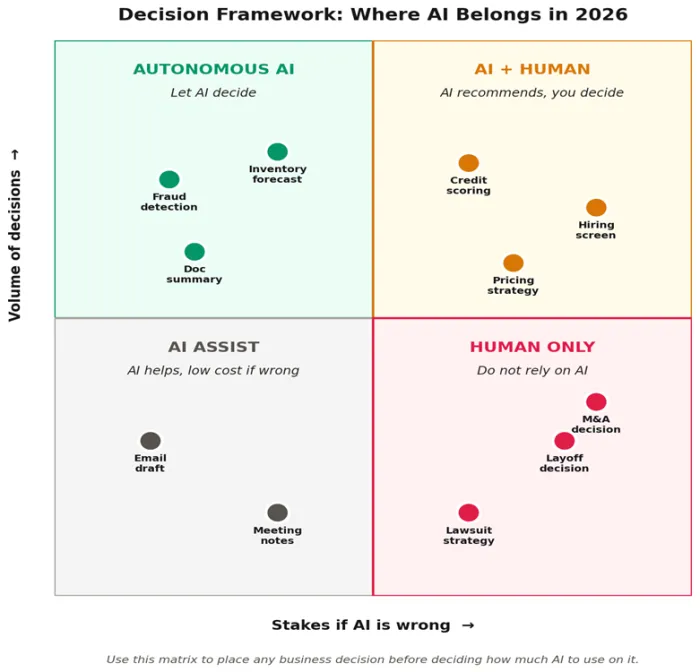
The decision matrix in action. Any business decision lands in one of four zones, each with a different level of AI involvement.
Here is how to read each quadrant:
Top-left: Autonomous AI High volume, low cost if wrong. Let AI decide. Examples: fraud scoring, inventory replenishment, document summarization, ad bid optimization. Human role: set the rules, monitor the metrics, intervene only on flagged exceptions. |
Top-right: AI plus human High volume, high cost if wrong. AI recommends, human decides. Examples: credit approvals, hiring screens, pricing strategy, investment recommendations. Human role: review every recommendation that crosses a threshold, override when needed, document the reasoning. |
Bottom-left: AI assist Low volume, low cost if wrong. AI helps but humans drive. Examples: email drafts, meeting notes, internal reports, presentation slides. Human role: edit, polish, and own the final output. Use AI as a writing partner, not an author. |
Bottom-right: Human only Low volume, high cost if wrong. Do not let AI drive this. Examples: M&A decisions, layoff lists, lawsuit strategy, crisis response, executive hiring. Human role: own the decision entirely. AI may provide background research, but the decision belongs to a human with accountability. |
Real Business Case Studies
Klarna, JPMorgan, Walmart, and More
Theory is one thing. The real test is what is shipping in production at large enterprises. Below are six verified deployments from 2025 to 2026 with public outcome data. Each one is in the trust or verify zone of the framework above.
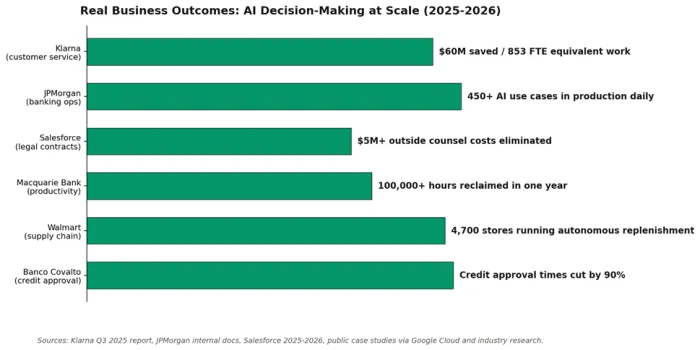
Klarna's AI agent now handles customer service work equivalent to 853 full-time employees. The company reported $60 million in annual savings by Q3 2025, with average resolution time dropping from 11 minutes to under 2 minutes.
JPMorgan runs more than 450 AI use cases in production daily across investment banking, fraud detection, and document review. The bank's AI agents generate first-draft M&A memos in 30 seconds compared to the hours junior analysts previously spent.
Salesforce eliminated more than $5 million in outside legal counsel costs by deploying AI for contract review and analysis. The system flags risk clauses and unusual terms, but final approvals still go through the legal team.
The thread connecting all of these is the same: AI is doing the volume work, humans are owning the judgment calls. None of these companies removed humans from the loop on consequential decisions. They removed humans from the loop on the 80 percent of work that does not require human judgment in the first place.
The AI Project Funnel
Why Most Pilots Never Pay Off
For every AI deployment that works, there are many more that do not. The numbers from MIT, RAND, Gartner, and S&P Global show how steeply the funnel narrows from pilot to lasting business value.
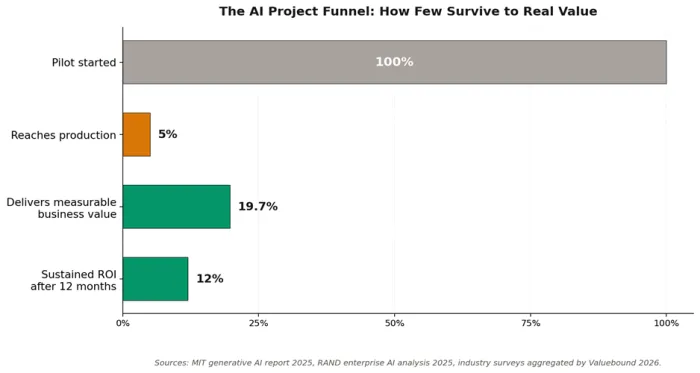
The AI project funnel. Of every 100 pilots, only 5 reach production, and only a fraction of those deliver sustained business value.
Gartner predicts that 60 percent of AI projects without AI-ready data will be abandoned by 2026. S&P Global found that 42 percent of companies scrapped most of their AI initiatives in 2025 alone.
The failure pattern is consistent across industries. Pilots launch with vague success metrics, run on incomplete or low-quality data, and are sponsored by leadership that does not understand what success looks like. Six months later, the project is quietly retired and the spend is written off as a learning experience.
The companies that get to the 12 percent sustained ROI bracket share three habits. They define the specific decision the AI will make before they build anything. They invest in data quality before they invest in model quality. And they tie the AI deployment to a measurable business metric that the executive sponsor cares about.
Regulations and Compliance
EU AI Act, NIST, and SEC
Regulators are now treating AI as a governance issue, not a technology issue. The phrase regulators use repeatedly is that innovation is no longer a valid excuse for harm. Three frameworks matter most for any business deploying AI in 2026.
EU AI Act, effective August 2, 2026
The world's most comprehensive AI regulation classifies systems by risk level. High-risk applications (employment, credit scoring, education, law enforcement) require documented governance, human oversight, and explainability. Unacceptable-risk applications (social scoring, manipulation) are banned outright. Fines can reach 35 million euros or 7 percent of global revenue, whichever is higher.
NIST AI Risk Management Framework
The U.S. standard for trustworthy AI uses a four-part approach: govern, map, measure, and manage. The 2025 update extended this model to include privacy and data-protection risks. It is the de facto playbook for AI governance in regulated U.S. markets.
SEC and financial regulators
The U.S. Securities and Exchange Commission has made it clear that the use of advanced analytics or AI does not exempt firms from existing regulations. Banking regulators in the UK (FCA, Bank of England) found that 75 percent of financial services firms now use AI, and supervisory expectations have risen accordingly.
The practical implication for any business: if you are using AI to make decisions that affect customers, employees, or the public, you need documented governance before something goes wrong, not after.
Seven-Step Adoption Checklist for Business-Critical AI
Reading frameworks is not the same as using one. The seven steps below are the working checklist. Use this list before launching any AI deployment that affects business decisions.
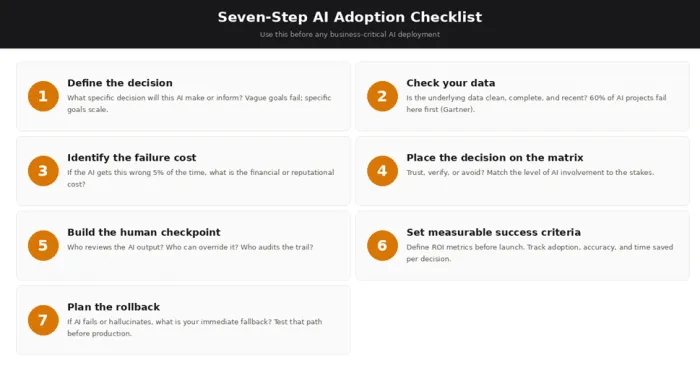
A note on step 5 (the human checkpoint). This is the step where most enterprises cut corners and then regret it. A human checkpoint is not a notification that an AI made a decision. It is a real review, by a person with authority, of any decision that meets a defined threshold. If the human cannot actually override the AI, the checkpoint is theater.
A note on step 7 (the rollback plan). The rollback should be tested before production launch, not designed after the first incident. The Allianz Risk Barometer 2026 specifically calls out lack of incident-response plans as a leading driver of AI-related losses.
Final Recommendation
The honest answer to whether you can rely on AI for business decisions is: it depends entirely on the decision. The companies winning with AI in 2026 are not the ones using it everywhere. They are the ones using it precisely where it works, and explicitly not using it where it does not.
| Decision type | Rely on AI? | Notes |
|---|---|---|
| Fraud detection | Yes, autonomously | Human reviews flagged exceptions only |
| Demand forecasting | Yes, autonomously | Track forecast accuracy monthly |
| Customer service routing | Yes, autonomously | Escalate edge cases to humans |
| Credit and lending decisions | With human review | Required by EU AI Act for high-risk applications |
| Hiring and screening | With human review | Audit for bias quarterly, document the process |
| Pricing strategy | With human review | Set guardrails to prevent runaway pricing |
| Layoffs and terminations | No | Legal exposure, ethical risk, EU AI Act restrictions |
| M&A decisions | No | AI may research; humans must decide |
| Legal strategy and filings | No | Hallucination risk is too high for court use |
| Crisis and PR response | No | Requires human judgment AI cannot replicate |