Last winter I watched a friend stare at a blank Google Doc for forty minutes. She'd been writing for clients for nine years. Nine years. And she still froze at the first sentence - coffee going cold, three browser tabs open, none of them helping.
That moment is the freelance writing job in miniature. The actual writing is maybe a third of what we get paid for. The rest is research, briefs, pitches, edits, scope creep, follow-ups, invoices, and a slow-burning anxiety about the next deposit.
AI doesn't replace the writing part. (It usually shouldn't, and we'll get to that.) What it can do - quietly, without much drama - is absorb the surrounding work. The parts that drain hours without paying for them.
Below are twelve workflows I've either used myself or watched working writers adopt over the last two years. Each one is small. Stacked together, they hand back roughly a working week's worth of time per month.
| A note before we start: "saves time" is not the same as "skip the thinking." Every output below gets a human pass. The goal isn't writing more - it's writing better, with less of the friction in between. |
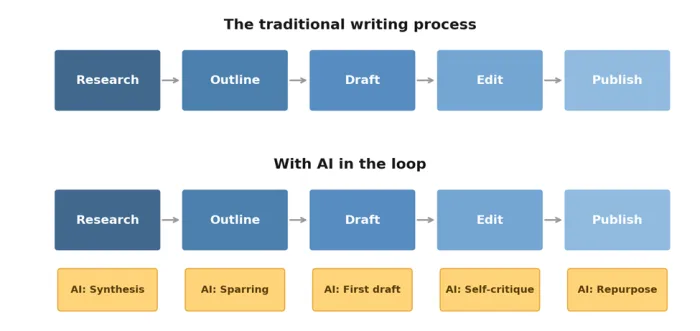
AI doesn't replace any stage. It runs alongside each one, handling the parts that don't need your voice.
Idea mining & topic angles
The hardest part of pitching new clients isn't the email. It's finding ten angles a real human editor hasn't seen six times this quarter. You sit with a topic - say, "workplace burnout"-and your brain hands you back the same three takes you've already written.
Here's what works. Hand the AI the topic, the publication's audience, and three constraints (tone, length, the angles you're tired of). Ask for fifteen pitches. You'll throw out twelve. The remaining three are usually sharper than what you'd have generated alone, because you weren't competing with your own self-censor.
Prompt scaffold I write for [publication]-audience is [who]. Give me 15 article angles on [topic]. Avoid: [3 takes you're sick of]. For each angle, give: a working headline, the central tension, and one expert I might quote. Be willing to suggest contrarian or uncomfortable framings. |
SEO brief in 15 minutes (instead of two hours)
Building an SEO brief from scratch is a real time sink-pulling SERP results, eyeballing intent, finding gaps, structuring an H2/H3 outline. Most of that is mechanical pattern-matching. Which is exactly what AI is good at.
The trick is feeding it the top three ranking pages first (paste the text, not just URLs), then asking it to identify what's missing, what's bloated, and what people are clearly searching for that nobody covered. You still make the editorial calls. But you start with a map instead of a blank page.
The outline as a sparring partner
I used to write outlines alone. Now I write them, then paste them into a chat with one instruction: find the weakest section and tell me why. The answers are sometimes wrong. They're frequently annoying. But about a third of the time, they catch a structural problem I would only have noticed during the third edit pass-by which point fixing it costs three hours, not three minutes.
Beating the blank page
This one is misunderstood. People assume you ask AI to draft the whole article. You don't. You ask it to draft the worst version of the article-deliberately generic, slightly clichéd, the version a tired junior writer would file. Then you read it and your brain instinctively starts arguing back. No, that's not the point. The actual point is…
And just like that, you're writing. The AI's mediocre draft becomes a punching bag, and your real piece emerges in opposition to it. Counter-intuitive, but it works for a lot of writers I've talked to.
| Treat the AI's first draft as a straw man, not a starting point. Your best writing usually shows up when you're disagreeing with something. |
Source synthesis & research compression
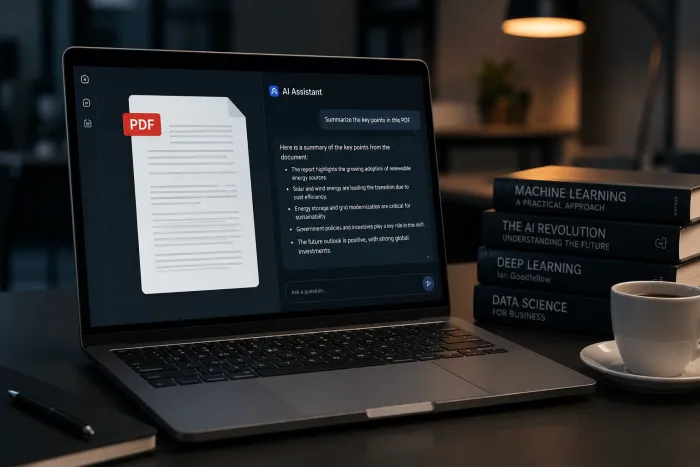
You have nine PDFs, two transcripts from interviews, and a 40-tab research session. Somewhere in there is the article. Drop the lot into a long-context model and ask three questions: what are the recurring claims, what contradicts what, and what's the one thing nobody is explicitly saying but everyone is dancing around.
That third question is where the gold is. AI is surprisingly good at noticing absences-gaps in the conversation that human writers, deep in the material, often miss.
The self-edit pass before you submit
Before you send anything to a client, run it through one focused pass: act as a skeptical line editor for [publication]. Flag anything that's vague, unsupported, or sounds like filler. Don't rewrite-just point at what's wrong.
Most of its notes will be obvious. A few will be wrong. But one or two per piece will be the kind of catch a fresh editor would have made-the sentence that sounds smart but says nothing, the transition that's covering for a missing argument. Those catches alone justify the workflow.
Ten headlines, one keeper
Headlines are a numbers game. Generate twenty, and three will be usable. The trouble is that generating twenty headlines yourself takes an hour and feels like dental work. Generating twenty with AI takes ninety seconds, and your job becomes judging rather than producing-which is a much faster cognitive task.
Repurposing one article into six pieces
Most freelancers hand in a piece, get paid, and move on. The savvy ones know one well-researched 2,000-word article contains the seed for a LinkedIn post, a Twitter thread, a newsletter blurb, a short video script, an internal memo for the client's team, and a follow-up pitch on a related angle. AI handles the format conversion. You handle the editorial voice.
Result: clients see you as a content multiplier, not a word-count vendor. Rates tend to follow.
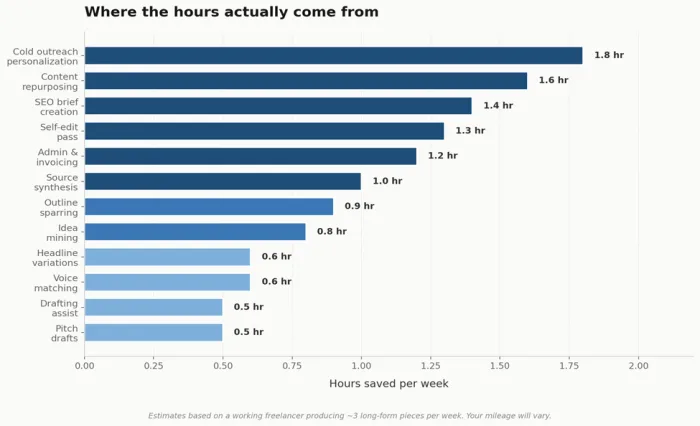
Where the time actually goes. The largest savings come from work that isn't really writing.
Pitch personalization at scale
You've got a list of fifty editors. You can either send a generic pitch to all of them (response rate: dismal) or write fifty real ones (time: most of your week). Or you write one strong pitch, then feed it to AI along with each editor's recent published work, and ask it to produce a personalized version that references something specific they've actually done.
You read each one. You catch the awkward bits. You hit send. Personalization rate: 100%. Time spent: about an hour for fifty pitches.
The boring-but-critical admin layer
Invoices. Project briefs. Statement of work documents. Onboarding emails. Late-payment reminders that don't sound passive-aggressive. None of this is glamorous. All of it eats hours.
Build a personal library of templates-generated once with AI, edited by you, saved to a Notion or Google Doc. Next time you onboard a client, you're filling in blanks instead of writing from scratch. The first week of building the library hurts. Every week after pays you back.
Voice matching across clients
If you write for a fintech newsletter and a craft brewery in the same week, you know the whiplash. Different voice, different rhythm, different vocabulary. Switching cleanly is a cognitive cost most clients don't see.
Keep a one-page "voice profile" for each recurring client: tone keywords, sentence-length preferences, words to avoid, three sample sentences they loved. Paste it at the top of your AI session before drafting. It nudges the model-and frankly, it nudges you-into the right register before you've written a word.
Cold outreach that doesn't sound like a robot
The irony of using AI for cold outreach is that bad AI outreach is what made cold outreach so hard in the first place. Editors and marketing managers can smell template-sludge from a thousand inboxes away.
The workaround: never let AI write the opening line. You write it. Reference something specific, recent, and human-a piece they shared, a comment they made, the city they're in. Then let AI handle the bridge to your pitch and the close. The opening makes it feel personal; AI handles the structure underneath. Ratio that works for me: 20% you, 80% AI, 100% sounds like a person.
Quick reference
Twelve workflows, the type of model that fits each, and a rough estimate of weekly time recovered. Numbers vary by output volume-they're directional, not gospel.
| # | Workflow | Best AI for the job | Approx. time saved/wk |
|---|---|---|---|
| 1 | Idea mining & topic angles | General-purpose chat | ~50 min |
| 2 | SEO brief in 15 minutes | Chat + research mode | ~85 min |
| 3 | Outline as sparring partner | General-purpose chat | ~55 min |
| 4 | Beating the blank page | General-purpose chat | ~30 min |
| 5 | Source synthesis & summarization | Long-context chat | ~60 min |
| 6 | Self-edit pass before submitting | General-purpose chat | ~80 min |
| 7 | Ten headlines, one keeper | General-purpose chat | ~35 min |
| 8 | Repurposing one piece into six | General-purpose chat | ~95 min |
| 9 | Pitch personalization at scale | Chat + browsing | ~30 min |
| 10 | Admin & invoicing templates | General-purpose chat | ~70 min |
| 11 | Voice matching across clients | General-purpose chat | ~35 min |
| 12 | Cold outreach without sounding off | Chat + browsing | ~110 min |
Times assume a freelancer producing roughly three long-form pieces per week and pitching weekly.
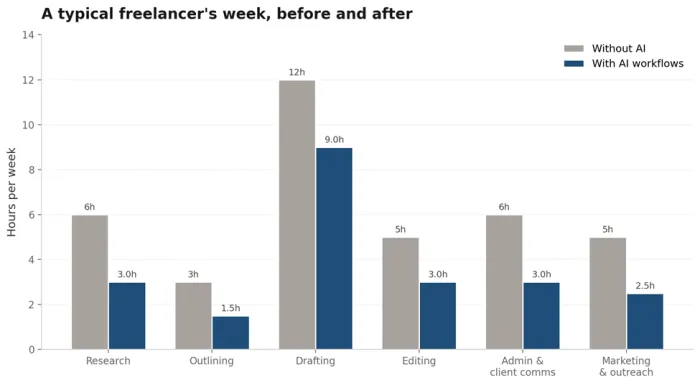
The big shifts aren't in drafting-they're in everything that surrounds the drafting.
A few honest caveats
These are tools. They are not collaborators.
If you start letting AI write what you actually think, two things happen-both bad. Your voice flattens, and your judgment atrophies. The workflows above all keep you in the driver's seat: editing, choosing, rejecting, sharpening. The moment you stop doing that work, the work stops being yours.
Disclose when it matters.
Some clients are explicit: no AI in the pipeline. Others don't care. Many haven't thought about it yet and will care later. When in doubt, say what you used and how. It's never cost me a contract. Hiding it once cost me a relationship.
Don't trust facts. Trust shapes.
AI is good at structure, summaries, framings, options, and patterns. It's bad at specifics-names, dates, statistics, quotes. Verify every fact independently. Treat AI output as a confident intern: useful, but you sign the work.
The 10-hour estimate is real, but lumpy.
You won't save 10 hours every week. Some weeks you'll save four. Some weeks you'll save fifteen. The savings show up in the boring weeks-the ones full of admin and pitching, when AI quietly absorbs the parts of the job that drain you. Those are exactly the weeks worth saving.
Final word
Freelance writing is going through a strange period. Some writers are panicking. Others are doubling down on craft and ignoring AI entirely. Both feel like the wrong move.
The writers I see thriving in 2026 are the ones who've quietly absorbed AI into the parts of the job that aren't really writing-research, admin, repurposing, outreach-and protected the parts that are. They're not faster writers. They're faster freelancers. The distinction matters.
Pick three of these workflows. Run them for two weeks. See what shows up in your calendar.
If a workflow on this list saved you an hour this week, that's the whole point.