
GitHub Copilot has become the default reference point for AI assisted coding, but its $10 per month Pro tier, $39 Pro Plus, $19 Business seat, and $39 Enterprise seat are not always feasible for solo developers, hobbyists, students past their education window, or independent contractors building unmonetized side projects. The good news for budget constrained developers in 2026 is that the alternative ecosystem has matured substantially. Free tiers from major vendors now cover daily coding work, open source self hosted stacks have closed most of the quality gap, and several paid plans sit well under the Copilot price.
The breakdown below covers eight credible options across three categories: vendor backed free tiers, open source local first stacks, and cheap paid plans under $13 per month. Pricing, feature limits, and free tier ceilings reflect data current as of May 2026. The Gemini Code Assist situation in particular requires attention since the product is being deprecated on June 18, 2026.
8 Credible tools covered | $0 to $12 Solo developer cost range | 180k Largest free tier completion cap |
Pricing Landscape at a Glance
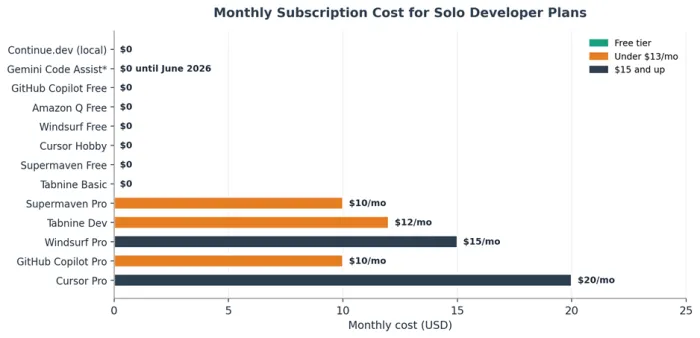
Before drilling into individual tools, a visual sweep of the cost ladder is useful. The chart below stacks every solo developer plan covered in this article from free at the top to $20 per month at the bottom.
| Chart 1: Monthly cost for solo developer plans across major AI code assistants |
 |
| Source: Vendor pricing pages verified May 2026. Annual billing on paid plans typically reduces effective monthly cost by 15 to 20 percent. |
Eight of the thirteen plans listed are free at the entry point. Among paid options, Supermaven Pro and GitHub Copilot Pro tie at $10 per month, Tabnine Dev sits at $12, and the higher tier IDEs (Windsurf Pro and Cursor Pro) reach $15 and $20 respectively. The remainder of this article focuses on the eight free options and the two cheapest paid tiers, since the $20 Cursor Pro price effectively matches the Copilot subscription it is meant to replace.
GitHub Copilot Free Tier
The first option worth weighing is the same product the article is meant to circumvent. GitHub introduced a free Copilot tier in late 2024 that has stuck around through the 2026 pricing reshuffle. It includes 2,000 code completions and 50 premium chat or agent mode requests per month, runs on GPT-4o mini class models, and works across VS Code, JetBrains IDEs, Neovim, Visual Studio, and Xcode.
Verified students, teachers, and maintainers of popular open source projects qualify for full Pro access at no cost through the GitHub Education program. For anyone in those groups, the budget question essentially disappears. Everyone else hits the 2,000 completion ceiling within one to two weeks of active coding, after which the tool stops suggesting anything until the next month resets.
The free tier is genuinely useful for evaluation, weekend coding, or as a fallback when other quotas run dry. It does not replace a daily driver for full time development.
Windsurf Free Tier from Cognition
Windsurf, the AI first IDE that emerged from Codeium's 2024 rebrand and is now owned by Cognition (the team behind Devin), offers a free tier with 25 monthly credits, agent mode access, and Cascade multi file editing. The Codeium VS Code extension still exists separately and has historically been more generous on autocomplete, though both products now share the same SWE-1.5 proprietary coding model that Cognition reports as roughly 13 times faster than Sonnet 4.5 on coding workloads.
Windsurf earns recognition for being the only free tier IDE in this list that ships with a working agent (Cascade). It can read files, write code, run terminal commands, and iterate on a task across multiple files. The 25 credit cap, however, exhausts quickly during agentic work, after which the user falls back to autocomplete only. Anyone planning to lean heavily on agent mode will outgrow the free tier within a week.
The Pro tier at $15 per month adds 500 monthly credits and unlocks heavier Cascade use. That sits above the Copilot Pro price but below Cursor Pro. For users specifically wanting an IDE level experience rather than a plugin, Windsurf Pro is the cheapest path.
Gemini Code Assist Before June 18, 2026
Deprecation notice Google has confirmed that Gemini Code Assist IDE extensions and the Gemini CLI will stop serving requests for individuals and Google AI Pro and Ultra tiers on June 18, 2026. Users are being migrated to a new product called Antigravity (and Antigravity CLI). Any reliance on the current Gemini Code Assist free tier should be considered short term as of this writing. |
Until the deprecation date, Gemini Code Assist remains the most generous free tier in the category. The individual plan covers 180,000 code completions per month (roughly 6,000 per day) and 240 chat requests per day, runs on Gemini 2.5 models, and includes AI powered code reviews with source citations. The free tier alone has been sufficient for full time development by most user reports.
The Antigravity migration introduces uncertainty. Google describes Antigravity as a unified multi agent platform with an individual plan that continues free access at higher limits, but the specifics of the new free tier had not been finalized as of mid May 2026. For solo developers, the practical guidance is to enjoy the current Gemini limits through mid June and prepare a fallback option before the cutover.
Free Tier Capacity Comparison
Capacity, not just price, determines whether a free tier holds up under real workloads. The chart below compares monthly completion ceilings across the five major free tier offers.
| Chart 2: Approximate monthly code completion capacity on free tiers |
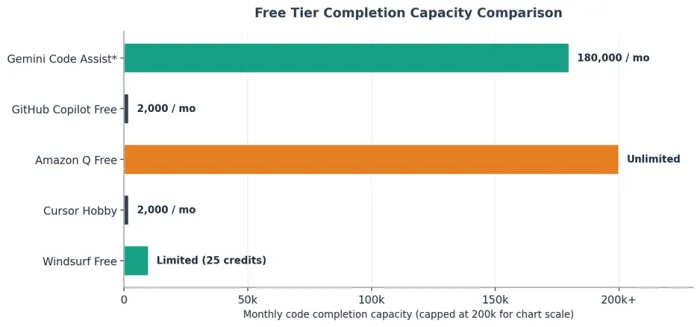 |
| Amazon Q lists unlimited chat and code completions on its Free tier; only the 50 monthly agentic requests are capped. Gemini figure shown is current until the June 18, 2026 deprecation. |
Amazon Q Developer Free Tier
Amazon Q Developer (the renamed CodeWhisperer) offers an unusually capable free tier: unlimited code completions, unlimited chat, 50 agentic requests per month, 1,000 lines of Java code transformation per month, and security scanning. Sign in is through an AWS Builder ID, which is free and does not require an AWS account.
The breadth of the free tier is genuinely uncommon. Most competitors gate either chat or completions; Amazon Q gates only the agent and transformation features. Code transformation is heavily Java focused, which limits its appeal for Python or TypeScript developers, but the core completion and chat experience works across 25 plus languages.
The trade off is identity gravity. Amazon Q nudges users toward AWS specific suggestions and integrates most deeply with AWS infrastructure. Developers working entirely outside the AWS ecosystem still get value from the free completions, but the chat assistant frequently steers solutions toward AWS managed services even when alternatives exist.
Cursor Hobby Plan
Cursor's free tier (called Hobby) offers limited Agent requests and limited Tab completions monthly, with no credit card required. Documented free tier completions sit at 2,000 per month with 50 slow premium model requests, similar in scale to the GitHub Copilot Free tier.
Cursor's strength is the editor itself, not the free tier. The VS Code fork is unusually well integrated with multi file editing, Composer agent mode, and the fastest autocomplete in the market (a capability inherited from the 2024 Supermaven acquisition). The Hobby tier exposes enough of that experience to evaluate Cursor, but the free quota is not sufficient for daily full time work.
Pricing notes worth flagging: verified students get Cursor Pro free for one year via SheerID, a $240 value. Outside that window, Pro is $20 per month, which matches the original Copilot Pro plus tier price point.
Continue.dev with Local Models
Continue.dev is an MIT licensed open source VS Code and JetBrains extension that turns any OpenAI compatible API endpoint into a Copilot style assistant. The endpoint can be a cloud API (OpenAI, Anthropic, Mistral), or a local Ollama, LM Studio, or vLLM server. The local option is the route that gets the recurring cost to zero.
The recommended local stack as of mid 2026 pairs Continue.dev with Ollama running Qwen2.5-Coder 7B for autocomplete and a larger model (Qwen2.5-Coder 32B or DeepSeek Coder V2 16B) for chat. Code never leaves the machine, which matters for proprietary or regulated work. Configuration is a JSON file specifying which model handles autocomplete, which handles chat, and which provides embeddings for the @codebase context provider.
The cost gets traded from monthly subscriptions to hardware. Continue.dev with a 7B coding model needs at least 8 GB of GPU VRAM for usable performance. A used RTX 3090 with 24 GB sits around $700 to $900 on the secondary market in 2026 and runs the recommended models comfortably. On Apple Silicon, the M4 Max with 64 GB unified memory is the leading laptop option. The cumulative cost chart that follows captures when the hardware investment crosses below the cloud subscription line.
| Chart 3: Cumulative cost over time, cloud subscriptions vs one time local hardware |
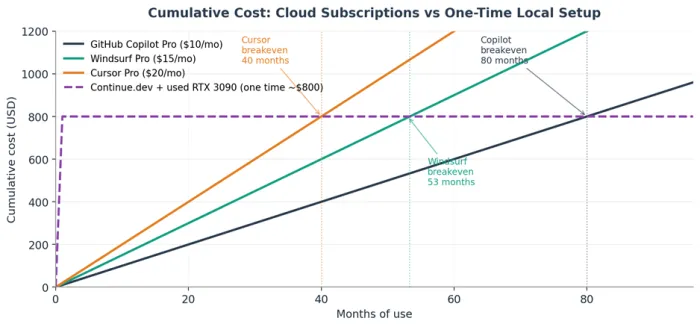 |
| Hardware cost shown is a used RTX 3090 at approximately $800. Electricity and depreciation are not included; the actual breakeven shifts modestly when those are added. |
Breakeven against Cursor Pro arrives in about 40 months, against Windsurf Pro in 53 months, and against Copilot Pro in 80 months. The local stack starts saving money quickly for users on the higher priced cloud tiers and takes longer to justify against the cheaper subscriptions. The non monetary benefits, full offline operation and zero data egress, often matter more than the dollar math.
Tabnine and Supermaven Under $13
Two paid plans deserve mention specifically because they sit below the $13 mark and offer something the free tiers do not.
Tabnine's Dev tier at $12 per user per month is the only privacy first paid option in this price range. Tabnine has supported on premise and self hosted deployment longer than any competitor, holds GDPR, SOC 2, and ISO 27001 certifications, and explicitly does not train on user code. The Basic free tier exists (recent listings confirm it was reinstated after a 2024 retirement) but is limited in features. For developers handling client code under confidentiality obligations, Tabnine Dev is often the cheapest defensible option.
Supermaven Pro at $10 per month (billed annually) brings a 1 million token context window, which is larger than the standard context in any other tool at this price. Supermaven was acquired by Cursor in 2024, but the standalone plugin continues to operate and integrates with VS Code, JetBrains, and Neovim. The free tier preserves the full 1 million token context, which makes Supermaven the most context capable free option among VS Code plugins.
Feature Capability Comparison
Price and capacity tell only part of the story. The radar profile below maps four representative free options against seven dimensions that matter for daily coding work.
| Chart 4: Capability profile across seven dimensions for four free options |
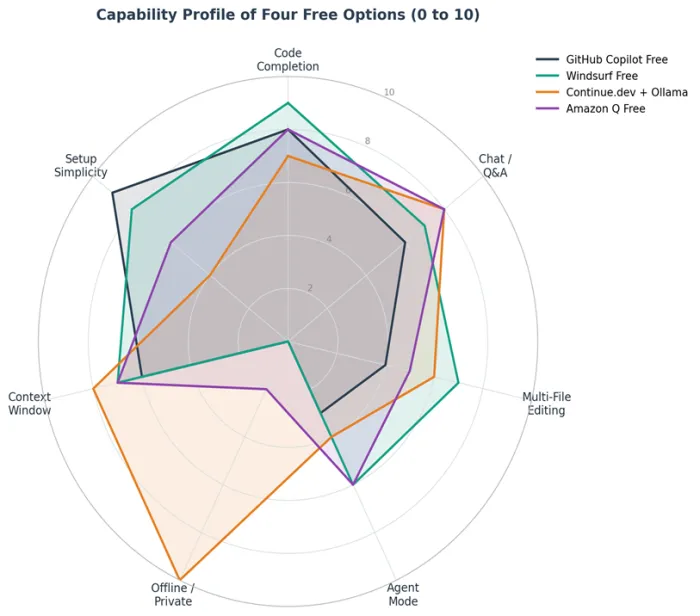 |
| Scores reflect comparative reviewer testing during March and April 2026 on a 0 to 10 scale. Specific tasks may favor a tool that scores lower overall. |
The shape differences are informative. Continue.dev plus Ollama dominates the offline and context window axes but trails on setup simplicity (config files, GPU drivers, model selection). Windsurf Free leads on agent mode and multi file editing among free tiers. GitHub Copilot Free wins on setup simplicity but trails on agent and offline. Amazon Q Free is the most balanced profile, with no axis where it scores poorly except offline use.
Feature Matrix at a Glance
| Capability | Copilot Free | Windsurf Free | Amazon Q Free | Continue + Ollama |
| Inline completions | 2,000 / month | Generous | Unlimited | Unlimited |
| Chat or Q&A | 50 / month | Limited credits | Unlimited | Unlimited |
| Agent mode | Limited | Yes (25 credits) | 50 / month | Possible via tools |
| Multi file editing | Basic | Cascade | Limited | Yes |
| Offline operation | No | No | No | Full |
| Privacy posture | Standard cloud | Standard cloud | AWS cloud | Fully local |
| Setup effort | Minimal | Low | Low | Moderate to high |
| IDE coverage | VS Code, JetBrains, Vim | VS Code, JetBrains | VS Code, JetBrains | VS Code, JetBrains |
Where Each Tool Falls Short
Every option on this list has documented weaknesses. Honest evaluation requires naming them.
GitHub Copilot Free runs out of completions fast. Two thousand monthly completions sounds generous but disappears within ten to fourteen days of full time work. The 50 chat or agent request cap is hit even faster. The free tier is meant as a funnel to Pro, not as a sustainable daily driver.
Windsurf Free is the lowest credit ceiling in the category. Twenty five monthly credits can be exhausted in a single afternoon of agent work. The Cascade agent itself is capable but throttled to the point where most users either upgrade or fall back to the Codeium plugin's completion only mode.
Gemini Code Assist is days away from a major product migration. The product as it stands today will not be available after June 18, 2026. The replacement product, Antigravity, may or may not preserve the current limits. Building a workflow on the current free tier is a short term move.
Amazon Q Free leans heavily AWS. Outside the AWS ecosystem the assistant becomes noticeably less useful, and the IP indemnification that justifies Q Pro for enterprise users is missing from the free tier.
Continue.dev requires technical setup. Configuration, model selection, GPU drivers, and Ollama installation collectively take an evening for an experienced developer and longer for newcomers. The 7B local models lag the frontier cloud models on complex multi file refactoring. The 32B local models close the gap but require 24 GB VRAM.
Tabnine has limited model selection. The platform supports OpenAI integration but does not match the multi model flexibility of Cursor or Windsurf. Some reviewers note the proprietary model still trails GPT-4 class output on complex generation tasks.
Supermaven is autocomplete focused. It excels at the prediction task but lacks the multi file editing and agent capabilities that Cursor (its parent company) sells at a higher tier. Treating Supermaven as a complete IDE replacement understates what it does and does not cover.
Choosing Based on Project Type
The right pick depends less on absolute capability and more on what the developer is actually building. The decision matrix below maps common solo developer profiles to the strongest free or near free option.
| Developer profile | Best free pick | Reason |
| Verified student or OSS maintainer | GitHub Copilot Pro (free) | Full Pro via Education or Maintainers program |
| Weekend coder, 2-4 hours per week | GitHub Copilot Free | 2,000 completions covers light use |
| Active solo dev, 8+ hours per day | Amazon Q Free | Unlimited completions and chat |
| AWS native infrastructure work | Amazon Q Free | Deepest AWS integration in free tier |
| Client code under NDA | Tabnine Dev ($12) or Continue + local | Privacy first or fully offline |
| Heavy agent and multi file work | Windsurf Free initially, then Pro | Only free tier with working agent |
| Already has a 24 GB GPU | Continue.dev + Ollama | Zero ongoing cost, full privacy |
| Java migration or transformation | Amazon Q Free | 1,000 lines of free Java transformation |
| Wants fastest autocomplete | Supermaven Free | 1M token context, fastest prediction |
| Until June 18, 2026 only | Gemini Code Assist | Highest free completion ceiling in market |
Bottom Line
The 2026 AI code assistant market is no longer a market where solo developers without Copilot budget have to compromise on quality. Amazon Q Free has the strongest single free tier for general purpose coding outside AWS specific work. Gemini Code Assist held the top spot on raw capacity until the upcoming Antigravity migration introduced uncertainty. Windsurf Free is the only credible free agent IDE. Continue.dev plus Ollama is the strongest privacy preserving option and the only fully offline option.
Among paid plans under $13, Supermaven Pro and Tabnine Dev cover distinct needs: context size and privacy, respectively. Both undercut GitHub Copilot Pro on price and target users who want one specific capability handled exceptionally well.
The practical recipe for a solo developer in mid 2026 is to start with Amazon Q Free as the daily driver, keep GitHub Copilot Free installed as a backup, evaluate Windsurf Free for any agentic work, and have a Continue.dev plus Ollama setup ready for offline or privacy critical projects. That combination provides full coverage at zero monthly cost, with the option to upgrade only when a specific use case justifies the spend.